
Exclusive Interview with Elly Kitaly, Executive Director of Chadron’s Hope Foundation
Nearly eight years ago, Elly Kitaly founded Chadron’s Hope Foundation after the birth of her son, Chadron. What began as a mother searching for information in a system with few resources has grown into a community-based organization providing early intervention services, psychosocial and economic support for mothers, and national awareness around Down syndrome in Tanzania. In this conversation, Elly shares her journey, the realities families face, and her vision for lasting change.
GLOBAL: Elly, tell us a little bit about yourself and how you got involved with Chadron’s Hope Foundation. What led you to where it is today?
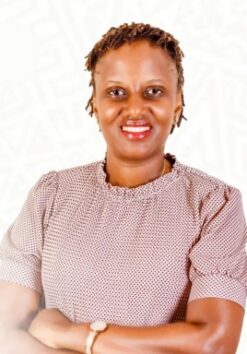 ELLY: My name is Elly. I’m a mother of two boys, Chadron and Darren. My background is in telecom engineering, but I had to stop working to support Chadron because there is not so much support for people with Down syndrome in Tanzania.
When the doctor told me, “Congratulations, you have a baby boy with Down syndrome,” I did not know what that meant. There was no pamphlet, no counseling, no explanation. The hospital had no network access, so I could not even search online. I remember leaving that area just so I could Google what Down syndrome was.
That moment began my journey. I had education and access to information once I found it, and still I struggled. I kept thinking about mothers who did not have those same resources. If it was this hard for me, what about someone raising a child alone, without information, without income, without support? That is why we formed Chadron’s Hope Foundation, with hope to improve the lives of people with Down syndrome and other neurodevelopmental disabilities.
GLOBAL: Prior to Chadron’s birth, had you ever met or known anyone with Down syndrome?
 ELLY: I had met someone when I was young, but I didn’t know it was Down syndrome. There was a young girl in town who had some condition, but we didn’t understand what it was. So when Chadron was born, everything was new to me. I was lucky that the doctors mentioned Down syndrome. Some families never even get told clearly what the condition is. But still, I didn’t understand what it meant. I had to teach myself.
Now when I speak in Tanzania about mosaic, translocation, trisomy 21, sometimes people think I’m a doctor. But I’m not. I’m an engineer. I just had to learn.
GLOBAL: You mentioned that many mothers are left to raise their children alone. Is it common in Tanzania for partners to leave after the diagnosis?
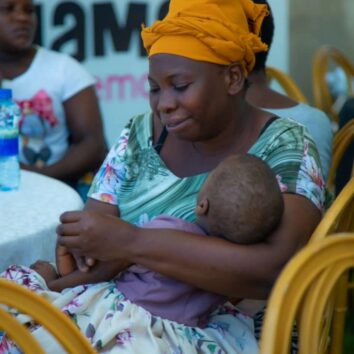 ELLY: Yes, it is common. Stigma is still strong in many communities. Some people believe disability is a curse or witchcraft. There is also economic pressure. When there is no formal support system, the responsibility can feel overwhelming. But mothers do not leave. They stay. One mother in our community shared that after her child was born with Down syndrome, the father left. There were days she did not have money for food. When you listen to her story, you understand the magnitude of the problem. It is not only emotional. It is economic. It is social. It is systemic. We are seeing change as awareness grows, but there is still a long way to go.
GLOBAL: How did Chadron’s Hope Foundation begin and how has it evolved?
ELLY: We are going to be legally registered for almost eight years. It started on Chadron’s third birthday. We asked our community and friends, instead of bringing birthday gifts, can they donate to support the registration and formalization of CHF. First, we started with awareness. We did media tours on local TV, radio, social media, even BBC World Service. Then we started supporting mothers directly. We gave seminars for mothers to help them accept their children and to teach simple exercises they could do at home because there are not many professionals like occupational therapists or speech therapists. As we continued, we realized that even if you teach all these wonderful things, if a mother cannot afford food or medical bills, we are not creating a sustainable model. That is when we formed a coalition called Mothers Raising Champions. We collectively save small amounts of money together and also ask the community to chip in. We support mothers economically, and we also teach financial management. During a time of national unrest, when families could not go out to work and some lost their business capital, we were able to support them with food and restart capital because of that coalition savings. That showed us how important economic empowerment is.

GLOBAL: What are your main programs today?
ELLY: We have Imara Therapy Center, where we provide early intervention services. Right now, we offer occupational therapy and home-based therapy because many parents are not able to bring their children due to financial hardship or lack of caregivers. We also have Mama Muema, which focuses on psychosocial support, counseling, and economic empowerment for mothers. That community is built by mothers and led by mothers. We have seven mothers who are leaders in that group. We continue to create awareness through media and by partnering with local leaders and hospitals. We believe that the best way to reach new mothers is by working with hospitals and social workers so they can refer families to us early.
GLOBAL: You’ve spoken about sustainability. What does that mean for you?
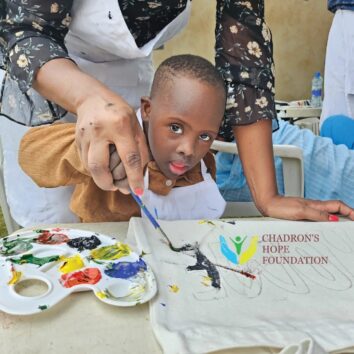
ELLY: We are positively making impact here in Tanzania. But the organization has grown beyond our capacity as friends and family supporting it.
Right now, we have six staff members. Four are paid full-time and two are volunteers. The team includes an occupational therapist, caregivers, and a communications officer. We are still short on specialists like speech therapists and physiotherapists.
Some families contribute to services when they can, sometimes as little as one dollar per visit. That helps, but it does not fully cover the costs. I carry multiple roles. I oversee finance, communications, leadership, and partnerships. We have proven for years that we can deliver impact. Now we need to strengthen our capacity so the work is sustainable. Imara Therapy Center is also part of that vision. We are building it as an income-generating arm so we are not fully dependent on external donors. In Tanzania, we say, “Teach us to fish, not give us fish.” We want to build long-term stability here at home.
GLOBAL: What are the biggest medical gaps you see in Tanzania?
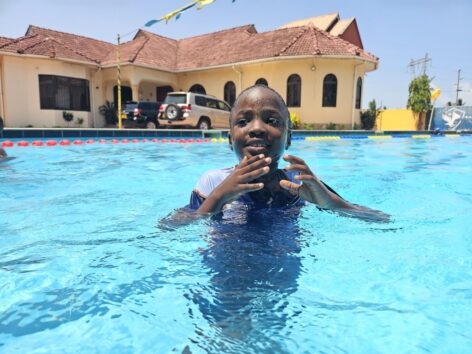
ELLY: Many parents do not receive clear medical guidance after diagnosis. There is no standardized checklist widely distributed that explains what health screenings are needed from childhood through adulthood. If a parent has knowledge and resources, they may ask for certain tests. But many families do not even know what to request. We are exploring partnership with Muhimbili University of Health and Allied Sciences to assess medical gaps for people with Down syndrome in Tanzania. What services are available? What are families actually receiving? What equipment or diagnostic tools are missing?
We also believe partnership between doctors across countries is important. Health patterns and access can differ by region, and there is much to learn from each other. If we can localize global medical guidelines in a way that fits Tanzania’s system, that could be transformative.
GLOBAL: What would you like the GLOBAL community to understand about your work?
ELLY: First, I am deeply grateful for partnership and collaboration. Even sharing resources and knowledge makes a difference. Second, I want people to know that real impact is happening in Tanzania. We have built a growing community of mothers. Children are receiving therapy. Awareness is increasing. But we are still building systems from the ground up. What we need most now is support to build our capacity, especially for staff and operational stability, so the work does not rely only on volunteering. I truly believe that if we strengthen this foundation now, we can create lasting change in Tanzania.
GLOBAL: Any final thoughts?
ELLY: I hope that one day a mother in Tanzania who gives birth to a child with Down syndrome will receive clear information, support, and dignity from the beginning. I also hope for children growing up with access to therapy, education, and eventually adulthood options like individualized assisted living, which does not yet exist here. We are working toward that environment.
I am grateful for this opportunity, and I look forward to what we can achieve together.

Learn More
Website: Chadron’s Hope Foundation | Our Programs
Instagram: Chadron’s Hope Foundation (@chadronfoundation)
Facebook: Chadron Foundation | Facebook
In 2019, the BBC produced a documentary about Elly and Chadron’s journey. To learn more, read the article below:
- ‘There is no word for Down’s syndrome in my language’ (English)
- ‘There is no word for Down’s syndrome in my language’ (Swahili)
Swahili Translation of Medical Guidelines
- GLOBAL Adult Guideline for Adults with Down Syndrome
- AAP Health Supervision Guidelines for Children and Adolescents with Down Syndrome
- Prenatal & Newborn Pamphlet (PNP)
Recent Posts
- Exclusive Interview with Elly Kitaly, Executive Director of Chadron’s Hope Foundation
- Dr. Nicole Baumer To Receive Prestigious Pueschel/Tjossem Research Award
- Sie Center Pilot Research Grant to Fund Pediatric Swallowing Screening
- GLOBAL Marks World Down Syndrome Day with Publication of Milestone Review of New Medical Guideline
- Emmy Award-Winning, Multi-Platinum Singer-Songwriter Rachel Platten & Ambassador Crystal Muro to Headline AcceptAbility Gala in Washington DC!
 Experience our inspirational and groundbreaking videos and photos. Our children and self-advocates are beautiful AND brilliant!
 Make sure your local Representatives are on the Congressional Down Syndrome Task Force.