

Global Honors Anna Sie as Community Leader
March 3rd, 2015 by Global Down Syndrome Foundation
on World Down Syndrome Day at Children’s Hospital Colorado. Mrs. Sie is a loving grandma and longtime supporter of the differently-abled.
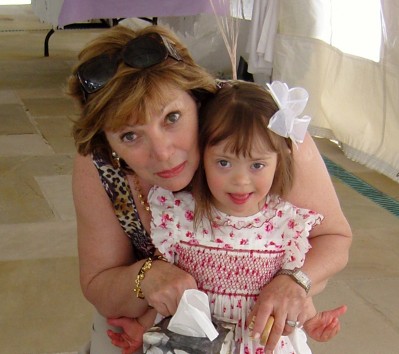
Anna Sie and granddaughter Sophia
The Global Down Syndrome Foundation is proud to announce longtime supporter Anna Sie will receive the Global Community Leadership Award at the World Down Syndrome Day celebration at Children’s Hospital Colorado on Friday, March 20, 2015. The celebration is co-hosted by Global and the Sie Center for Down Syndrome – one of the largest pediatric medical care centers dedicated to children with Down syndrome.
Mrs. Sie, along with her husband, John J. Sie, is the founding donor of the Global Down Syndrome Foundation, the Linda Crnic Institute for Down Syndrome, and the Anna and John J. Sie Center for Down Syndrome at Children’s Hospital Colorado.
She is also co-trustee of the Anna and John J. Sie Foundation, one of the largest funders of nonprofits dedicated to people who are differently-abled. Mrs. Sie’s philanthropy and advocacy focuses on issues relating to children’s welfare, health care, education and media. Her commitment to improving the lives of people with Down syndrome and the differently-abled is inspired by her granddaughter Sophia, who happens to have Down syndrome.
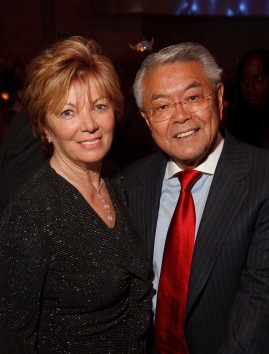
Anna and John J. Sie
“I want to make sure our granddaughter will benefit from anything we do,” Mrs. Sie said. “But that can’t happen if we don’t get to the bottom of these health issues for all people with Down syndrome. Helping my granddaughter, and the millions of others like her, is my mission and my passion in life.”
Mrs. Sie, a native of Italy, immigrated with her father and several brothers to the United States in 1955 and grew up in New Jersey. Her mother and two younger brothers came to America three years later. Her passion for the welfare of children was forged through her own experience in coming to America.
Anna and her husband John moved to Colorado in 1984 and have contributed to many aspects of Colorado’s growth. Together they have raised five children and are the proud grandparents to Sophia, Patrick, Benjamin and Shaela.
Jane Lynch Hosts Global and Self-Advocates
March 3rd, 2015 by Global Down Syndrome Foundation
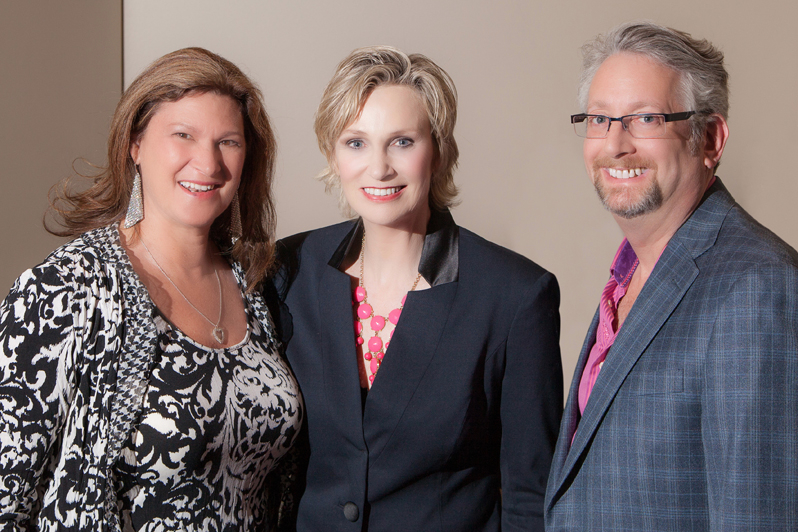
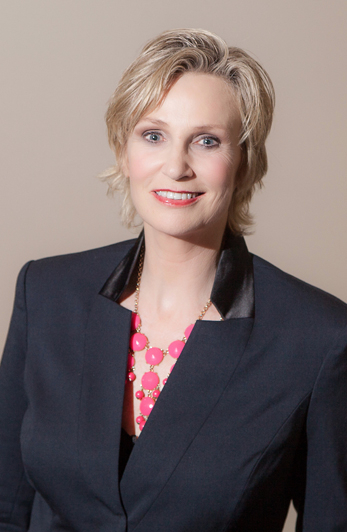
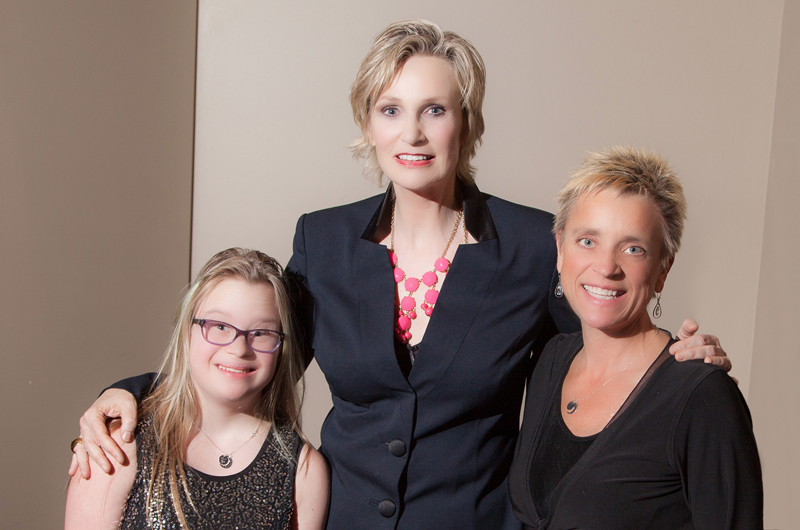
“Glee” star Jane Lynch recently brought her “See Jane Sing!” tour to Denver and graciously organized tickets for 30 Global Down Syndrome Foundation supporters. After her funny and engaging performance, the Emmy and Golden Globe Award winner met Global’s excited and grateful self-advocates and their families.
About the tour: “Fresh from her iconic portrayal of Sue Sylvester on ‘Glee’ and her Broadway debut as Miss Hannigan in ‘Annie,’ Jane will bring her comic skills and musical prowess to the theatre stage. Audiences should prepare for a side-splitting evening of musical comedy, with more than a dash of wit as Jane explores her love of the beauty and absurdity of the American standard and show tune. It’s Broadway with a twist.”
Learn more about her support and advocacy in the Spring 2015 issue of “Down Syndrome World” magazine, which will profile Lynch and “Glee” co-star Lauren Potter as they wrap up the final season of the hit show. Make sure you don’t miss out on the magazine by becoming a member of Global today.
Click the images to view a larger image. Click the large image to return to this page.






Global Down Syndrome Foundation at the Down Syndrome Affiliates in Action Conference
March 3rd, 2015 by Global Down Syndrome Foundation
The Global Down Syndrome Foundation is proud to support the 2015 Down Syndrome Affiliates in Action Conference on March 5-8 in Las Vegas. We look forward to seeing you at one of our five breakout sessions covering our new Global membership and grants program, social networking for adults, services for teens and adults, research benefiting people with Down syndrome, and the new Prenatal Testing Pamphlet.
Jamie Foxx, on Life with His Little Sister, DeOndra
February 10th, 2015 by Global Down Syndrome Foundation
In addition to being an all-star of her own accord, DeOndra Dixon is the youngest sister of Academy Award-winning actor and Grammy Award-winning singer Jamie Foxx.
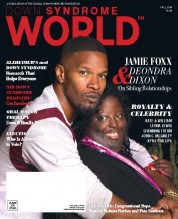
This article is an excerpt from Down Syndrome World magazine, a publication of the Global Down Syndrome Foundation. To receive Down Syndrome World, become a member of the Global Down Syndrome Foundation today at www.DownSyndromeWorld.org
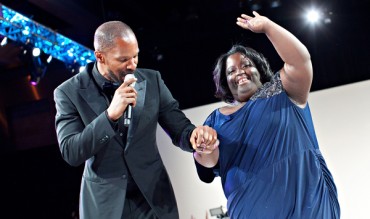 Oscar and Grammy winner Jamie Foxx is a triple threat as an actor, musician and comedian, and he’s also a great big brother to self-advocate DeOndra Dixon. Foxx, who is a Global Down Syndrome Foundation Quincy Jones Exceptional Advocacy Award recipient, recently spoke with us about DeOndra and how she’s earned her own place in the spotlight.
Q: Describe DeOndra for us.
A: She speaks her mind and knows that there’s nothing she can’t do. She has such a special quality, and she can light up a room. I don’t know where she gets it. It’s amazing.
Q: DeOndra’s a wonderful self-advocate. She speaks and learns well. What has contributed to her success?
A: It’s the way our family treats her. With DeOndra, we let her jump in the water and swim a little bit, so to speak. Our family just treats her like DeOndra. She goes everywhere we go. She’s usually the life of the party! I attribute a lot of that to my mother. She was the one who was making sure DeOndra went to school and got to be involved in all the activities. She always said, “Get out there and do your thing! Go to school, play, have fun — there’s nothing different about you!”
Q: What’s so special about DeOndra being a Global Down Syndrome Foundation Ambassador?
A: The Global Down Syndrome Foundation has changed my sister’s life. She’s so proud of what she does for the organization. She feels whole, and that’s the most important thing.
Q: What do you hope for DeOndra’s future?
A: That she can live her life with no boundaries, like she’s living it now. There’s nothing she can’t do.
Read the complete interview with Jamie and a profile of DeOndra in the inaugural issue of Down Syndrome World! Sign up as a member of the Global Down Syndrome Foundation and receive the first national quarterly magazine for the Down syndrome community.
Watch Jamie’s acceptance speech for the Quincy Jones Exceptional Advocacy Award:
Watch Jamie brag about DeOndra on the Queen Latifah Show:
Crnic Institute begins undergraduate scholarships
February 10th, 2015 by Global Down Syndrome Foundation
for students interested in Down syndrome research. They complement the graduate and postdoctoal fellowships organized by Crnic and funded by Global.
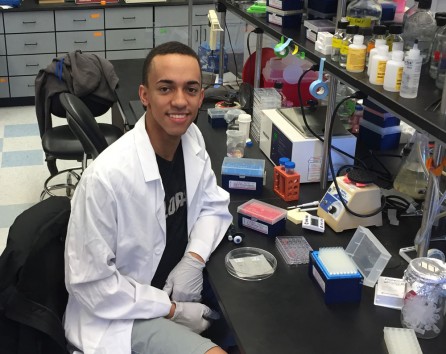
Darian Williams, Crnic Institute for Down Syndrome undergraduate scholarship recipient
A new Undergraduate Scholarship Program being offered through the Linda Crnic Institute for Down Syndrome and the University of Colorado has the potential to expand existing Down syndrome research and get a new generation of undergraduates interested in studying Down syndrome.
Darian Williams, a 20-year-old molecular, cellular, and developmental biology major at CU, is the first recipient of the Crnic Institute’s undergraduate research scholarship. Darian works in the laboratory of Bradley Olwin, Ph.D., a recipient of a 2014 Crnic Institute Grand Challenge Grant for his work on mechanisms of muscle dysfunction in Down syndrome. In addition to that work, Dr. Olwin researches muscular dystrophy and other muscle-related disorders.
“Our lab focuses on muscle stem cells, which are responsible for muscle repair and are often altered in conditions such as Down syndrome,” Williams said. “In our previous muscular dystrophy research, we used Ts65 mice, which exhibit many of the same characteristics as individuals with Down syndrome. Our preliminary experiments showed that these mice had defects in muscle stem cells, and we wanted to use that to better understand the function of these cells in individuals with Down syndrome.”
Expanding the Crnic Institute’s Reach
This is the first year the Undergraduate Scholarship Program has been offered through the Crnic Institute, and the pool of applicants included CU undergraduates interested in Down syndrome research.
“A combination of things made this possible, and one is certainly the funding we receive from the Global Down Syndrome Foundation,” said Tom Blumenthal, Ph.D., Executive Director of the Crnic Institute. “The other is the scientific problem itself. The available tools that can help us understand how the third copy of chromosome 21 causes all that it does are dramatically increasing. We’ve now reached a point where a concerted effort can enable us to understand the condition, and hopefully to intervene.”
Making Scientific Progress
The reality is that conducting biomedical research is increasingly expensive and requires a great deal of financial resources, Dr. Blumenthal noted. Through Global’s support, the Crnic Institute has gone from partnering with just two labs at the University of Colorado to partnering with 24.
The undergraduate scholarships come in addition to the existing Crnic Institute Grand Challenge Grants, which have provided $2.5 million to 27 research projects. Also, the Crnic Institute-affiliated Sie Post-Doctoral Fellowship Program at the BioFrontiers Institute funds three post-doctoral researchers. Recipients of these grants focus their work on medical and cognitive issues in individuals with Down syndrome, such as optic development and genetic analysis of autoimmunity.
“Our purpose is to make scientific progress,” Dr. Blumenthal said. “We hope that increasing the number of openings in our labs for interested undergraduate researchers helps us accomplish that.”
Dr. Blumenthal is excited about the future of Down syndrome research.
“We’re suddenly able to track this extra chromosome, where we weren’t before,” Dr. Blumenthal said. “It’s a matter of putting good money behind good science.”
Learn more about the research being funded by Global by checking out our Research & Medical Care section.
First T21 Research Society conference in Paris
February 10th, 2015 by Global Down Syndrome Foundation
The Global Down Syndrome Foundation is proud to announce that it has helped establish and is a Founding Member of T21 Research Society (T21RS) — the first international research society focused on Down syndrome.
  |
T21RS was founded to promote basic and applied research on Down syndrome, stimulate translational research and apply new scientific knowledge to develop improved treatments for people with Down syndrome and cures for diseases associated with the condition such as Alzheimer’s disease.
One of the society’s first major initiatives is the inaugural T21RS International Conference: Changing paradigms in Down syndrome, to be held in Paris from June 4 to 7 at the Brain and Spine Institute of the Salpêtrière hospital.
This conference will bring together renowned researchers, postdoctoral fellows and students from around the globe to share the latest scientific developments in the field of Down syndrome research. In addition, there will be a session with parents associations on Sunday, June 7.
“We are proud to have helped establish the Trisomy 21 Research Society. It is really an extension of Global’s commitment to greatly expand research benefiting people with Down syndrome,” said Michelle Sie Whitten, President and CEO of the Global Down Syndrome Foundation. “We are confident this new society will dramatically increase the number of scientists working on Down syndrome and therefore increase the number of breakthroughs we can witness in our lifetime.”
 The society will have a rotating presidency. The first president is Jean Maurice Delabar of Université Paris Diderot, who says the society’s membership is expected to double by the end of its second year after already exceeding its first-year goal in the initial six months.
Delabar will be followed by Roger Reeves, PhD, of Johns Hopkins University School of Medicine and a member of the Scientific Advisory Board for the Linda Crnic Institute for Down Syndrome.
 Reeves is a core faculty members of the McKusick-Nathans Institute of Genetic Medicine at Johns Hopkins and is considered one of the foremost experts in the field of gene expression in Down syndrome. Recent work by Reeves includes studies to identify what genetically contributes to the severity of cognitive and coordinative problems associated with Down syndrome in order to pursue therapies that could improve the lives of people with the condition.
 Also serving on the society’s advisory board and one of the founders of the society is Tom Blumenthal, PhD, Executive Director of the Crnic Institute. Blumenthal’s lab studies the mechanisms of gene expression and how genes are organized on chromosomes. He is a fellow of the American Academy of Arts and Sciences, one of the nation’s most prestigious honorary societies.
 The Crnic Institute’s Katheleen Gardiner, PhD, serves on the society’s Program Committee. Gardiner’s research focuses on protein expression in mouse and human model systems of Down syndrome, and she has organized the last two international conferences on Down syndrome and the biology of human chromosome 21 in Washington, DC.
Besides Global, founding supporters of the society include the Jérôme Lejeune Foundation, Lumind Foundation, Trisomy 21 France, and The Matthew Foundation.
Because Down syndrome research has generated findings that affect thinking regarding research on Alzheimer’s disease and solid tumor cancers, T21RS creates another forum for drawing attention to the need for further funding for Down syndrome research, which could in turn benefit everyone’s lives. Global and the Crnic Institute are at the forefront of this research and look forward to helping place a greater emphasis on collaborations worldwide.
For more information, go to t21rs.org.
Fashion designer Roberto Coin supports Global
January 5th, 2015 by Global Down Syndrome Foundation
through long-time Global partner Hyde Park Jewelers. A recent dinner with the famous Italian jewelry designer and thought-leader raised nearly $20,000.
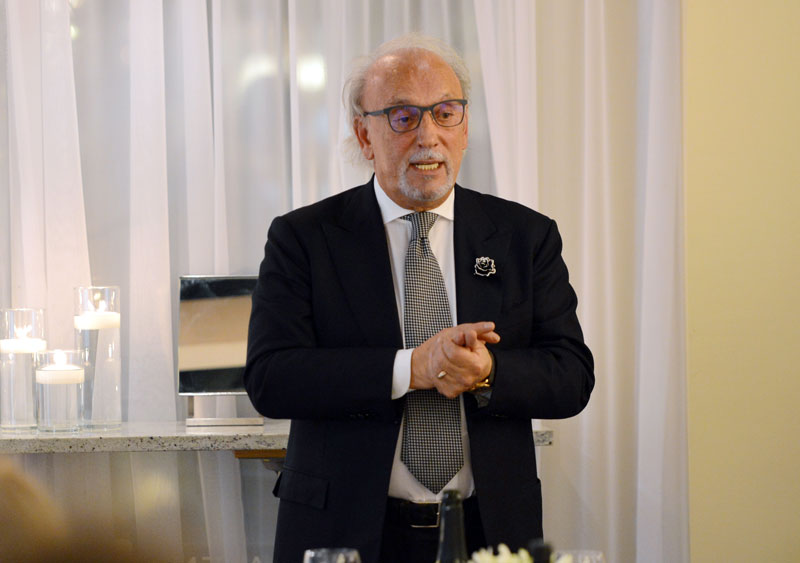 Internationally renowned jewelry designer Roberto Coin lent his help to benefit the Global Down Syndrome Foundation on December 10, 2014, as long-time Global partner Hyde Park Jewelers hosted a benefit dinner.
A portion of the proceeds from the dinner, at Pasta Pasta Pasta in Denver’s Cherry Creek North, went to Global, resulting in a gift of nearly $20,000. It’s the latest contribution in a long line of support from Hyde Park Jewelers. Hyde Park owners Shereen & Michael Pollak announced at the event that Hyde Park will continue to provide marquee items for the live auction at Global’s Be Beautiful Be Yourself Fashion Show. Past live auction gems from Hyde Park Jewelers have included trips to the Kentucky Derby paired with exclusive Longines watches, and a trip to Geneva, Switzerland, paired with an exclusive timepiece from Vacheron Constantin.
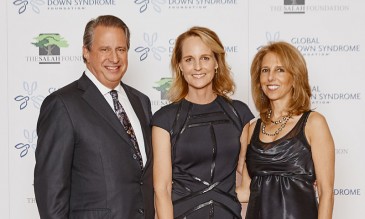
Michael and Shereen Pollak with Helen Hunt
Hyde Park Jewelers is one of the top 25 independent jewelers in the nation, with headquarters in Denver and stores at Denver’s Cherry Creek Shopping Center, Las Vegas and Phoenix.
Roberto Coin is one of the most sought-after jewelry brands in the world. From the Roberto Coin website:
In 1977, Roberto Coin founded the company that would bear his name in Vicenza, the city of Gold. Initially, the company was intended for production on behalf of some of the most prestigious brands of international fine jewelry. The Roberto Coin brand was launched in 1996. Success was quick and extraordinary. By 2000, only four years after the brand’s birth, Roberto Coin positioned itself seventh amongst the best-known jewelry brands in the United States. Two years later in 2002, the brand ranked third in the international panorama and first among Italian jewelers. The headquarters is in Vicenza, Italy and is assisted by foreign branches as well as by Roberto Coin Inc. on Fifth Avenue in New York City.
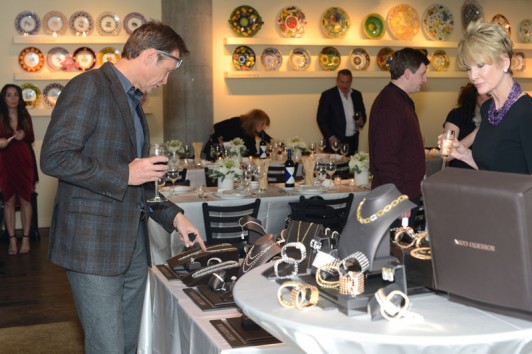 Hyde Park features a Roberto Coin boutique at its Denver location and says of the jewelry: Roberto Coin jewelry was the first to make use of three color gold which rapidly became a fashionable jewelry trend worldwide. Roberto Coin designs are known for their innovative craftsmanship and trendsetting use of color, whether rose, yellow or white gold or colored gemstones. The Roberto Coin design team uses age-old jewelry design techniques with modern innovations to create his famous necklaces, earrings and more.
Global is thankful for the support of Hyde Park Jewelers and Roberto Coin and looks forward to continuing partnerships in the future.
Renowned expert Patricia C. Winders shares her views
January 4th, 2015 by Global Down Syndrome Foundation
on the Sie Center for Down Syndrome at Children’s Hospital Colorado and her hopes for children with Down syndrome
This article is an excerpt from Down Syndrome World magazine, a publication of the Global Down Syndrome Foundation. To receive Down Syndrome World, become a member of the Global Down Syndrome Foundation today at www.DownSyndromeWorld.org
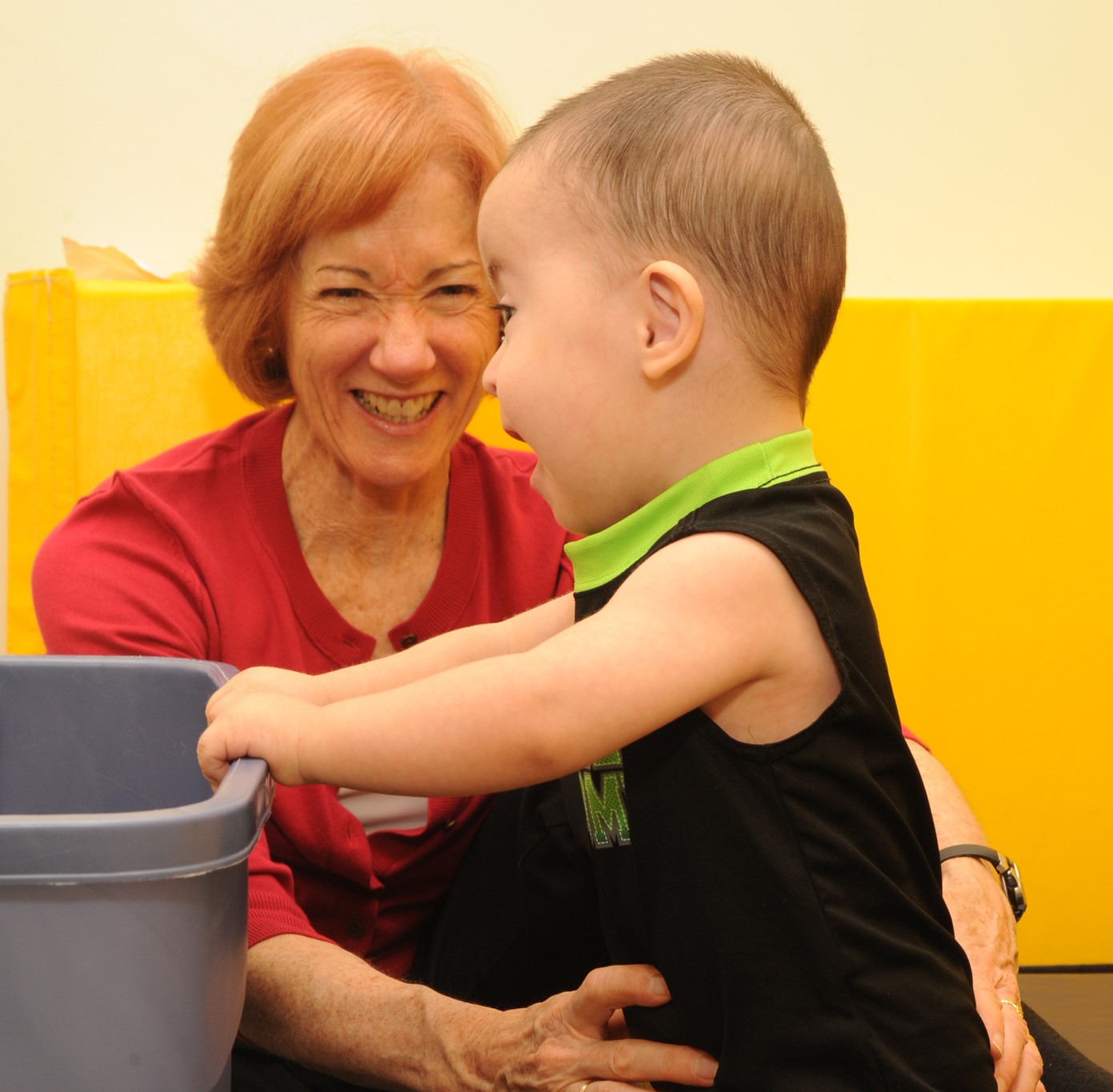
Described by her colleagues as “the most respected person in the field of Down syndrome and physical therapy,” Winders belongs to a passionate team of experts and empowers thousands of children with Down syndrome. Winders, Senior Physical Therapist and Director of Therapies at the Sie Center, is a kind, patient, yet no-nonsense sort of expert. The author of “Gross Motor Skills for Children with Down Syndrome: A Guide for Parents and Professionals (Second Edition),” she has often been quoted on her philosophy: “Physical therapy is a critical service, not because it will accelerate a child’s rate of development, but because it will improve a child’s long-term functional outcome.”
Winders, who has been with the Sie Center since it opened, recently spoke about her dream job.
Q: What were your plans when you came to the Sie Center?
A: I was excited to work with a comprehensive multi-disciplinary team of professionals dedicated to children who have this condition. The vision of Anna and John J. Sie created the opportunity to have this level of collaboration of clinical care specialists to provide the best care for the children and to do clinical research.
Q: Tell us about the care team.
A: Everyone here is a professional who has chosen to specialize in working with children who have Down syndrome. When we come together to focus on one child from our varying areas of expertise, the difference we’re able to make is enormous. Improving patient outcomes through a team effort is really the future of providing total care for children with disabilities.
Q: How do you approach your specialty, physical therapy?
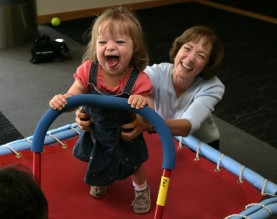
A: People who have Down syndrome can expect to live into their 60s, and they will need bodies that allow them to be active for that lifespan. As physical therapists, we help each child develop the body she will need as an adolescent and then as an adult. We focus on building strength, an optimal posture, and refined walking patterns. From birth to age 5, we teach gross motor skills such as rolling, sitting, crawling, walking, running, jumping, riding tricycles, and stair climbing. We want to help them develop that foundation and then use their bodies to do what they choose to do and what they love to do.
Q: What atmosphere have you created at the Sie Center?
A: We want it to be joyful. We don’t force children to practice skills if they are upset or not interested; we offer a different toy or propose a new activity they are motivated to do. We want to set them up to be successful learners. The physical space is beautiful, too. Our large motor room has a rock climbing wall and plenty of space for crawling and walking. Everybody’s eyes widen when they see it. One child stopped in the door and exclaimed, “Awesome!”
Helpful Tips from Patricia C. Winders
From “Down Syndrome Quarterly”
Follow the child’s lead
The child must be motivated to perform a particular skills. Trying to impose your will on a child with Down syndrome is a losing game. I often try to model my style of interaction after the parent’s. It is familiar to the child and most likely to be successful.
Be strategic in providing support
Children with Down syndrome tend to become quickly dependent on support. Provide as little support as possible while still allowing the child to succeed and remove the support as soon as possible.
Contact the Sie Center at 720-777-6750.
Global teams up with Alzheimer’s Association
January 2nd, 2015 by Global Down Syndrome Foundation
Awarding a total of $2.2 mil in Down syndrome-Alzheimer’s research grants. Samuel L. Jackson shares how his family has been affected by the disease
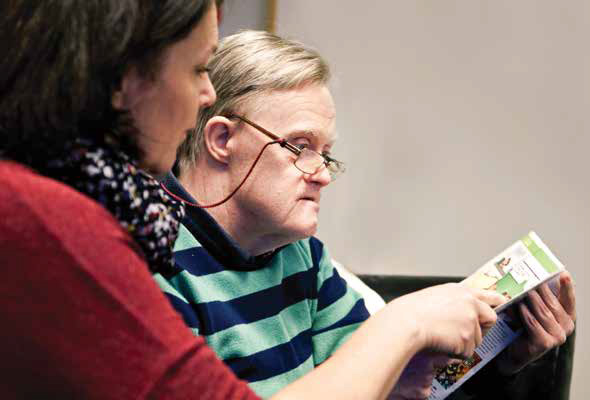
For the second year in a row, Global Down Syndrome Foundation, the Alzheimer’s Association and the Linda Crnic Institute for Down Syndrome are teaming up to to better understand the development of Alzheimer’s disease in individuals with Down syndrome and translate the research into improved treatments for people at risk to develop Alzheimer’s.
The organizations are supporting this growing area of study through a joint grant initiative called “Understanding the Development and Devising Treatments for Alzheimer’s Disease in Individuals with Down Syndrome.”
Why Down syndrome-Alzheimer’s disease research is important
One in eight older Americans suffers from Alzheimer’s disease, and 5.4 million Americans have Alzheimer’s today, with an estimated 13 million by 2050. One hundred percent of people with Down syndrome have the brain pathology of Alzheimer’s disease, and an estimated 50 percent will develop the symptoms before age 50. Recognizing that these conditions are “two sides of the same coin” and studying them together will hasten the development of new treatments for both.
The effects of Alzheimer’s are well-known, but it’s the personal stories that really make an impact. In a magazine article and video with the Hollywood Reporter, film megastar Samuel L. Jackson talks about his family’s “heartbreaking” struggle with Alzheimer’s. Read more at www.hollywoodreporter.com/news/samuel-l-jackson-opens-up-725419 and watch the video below.
2015 Research Grants
Global and the Alzheimer’s Association have already awarded $1.2 million in research grants to scientists around the world studying the connection between Down syndrome and Alzheimer’s disease, and a second round of grants, totaling $1 million, will be announced soon.
Previous Research Grants Awardees and Their Projects
In response to a Request for Application, more than 50 applications from around the world were received and vetted by the extensive peer review system at the Alzheimer’s Association with input from the Crnic Institute. The process resulted in five grants, including:
Three grants for senior investigators, each totaling $300,000:
- Investigator: Dr. Huaxi Xu, Sanford-Burnham Medical Research Institute, La Jolla, CA
Title: Roles of miR-155/C/EBPß/SNX27 pathway in Alzheimer’s disease/DS
- Investigator: Dr. Ann-Charlotte Granholm, Medical University of South Carolina, Charleston, SC
Title: Brain-derived neurotropic factor and executive dysfunction in DS
- Investigator: Dr. Karen Chang, University of Southern California, Los Angeles, CA
Title: Functional protein interactions in Alzheimer’s disease and DS
Two grants for new investigators, each totaling $150,000:
- Investigator: Dr. Donna Wilcock, University of Kentucky Research Foundation, Lexington, KY
Title: Inflammatory biomarkers to predict transition to dementia in DS
- Investigator: Dr. Eitan Okun, Bar-Ilan University, Ramat-Gan, Israel
Title: Developing a DNA vaccine for Alzheimer’s disease in patients with DS
Empowering Self-Advocates in Florida
December 30th, 2014 by Global Down Syndrome Foundation
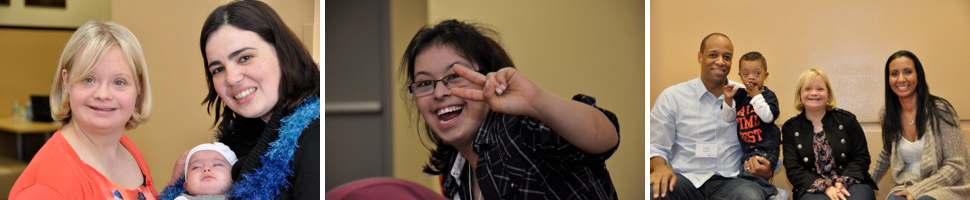
The Down Syndrome Association of Central Florida (DSACF) was founded by a small group of families sitting around a kitchen table in 1991. Since then, DSACF’s mission of hope, encouragement, and acceptance has grown exponentially.
This article is an excerpt from Down Syndrome World magazine, a publication of the Global Down Syndrome Foundation. To receive Down Syndrome World, become a member of the Global Down Syndrome Foundation today at www.DownSyndromeWorld.org
Today, the group’s reach spans 11 counties, impacting more than 1,100 individuals who have Down syndrome, along with their loved ones and medical teams.
Growing together
In addition to year-round programming, DSACF hosts an annual Step Up for Down Syndrome walk in downtown Orlando that attracts nearly 10,000 participants.
The organization also regularly holds expert educational seminars on topics of interest to parents, such as behavior and education. As a global Down Syndrome Educational Grant recipient, it hopes to expand that work.
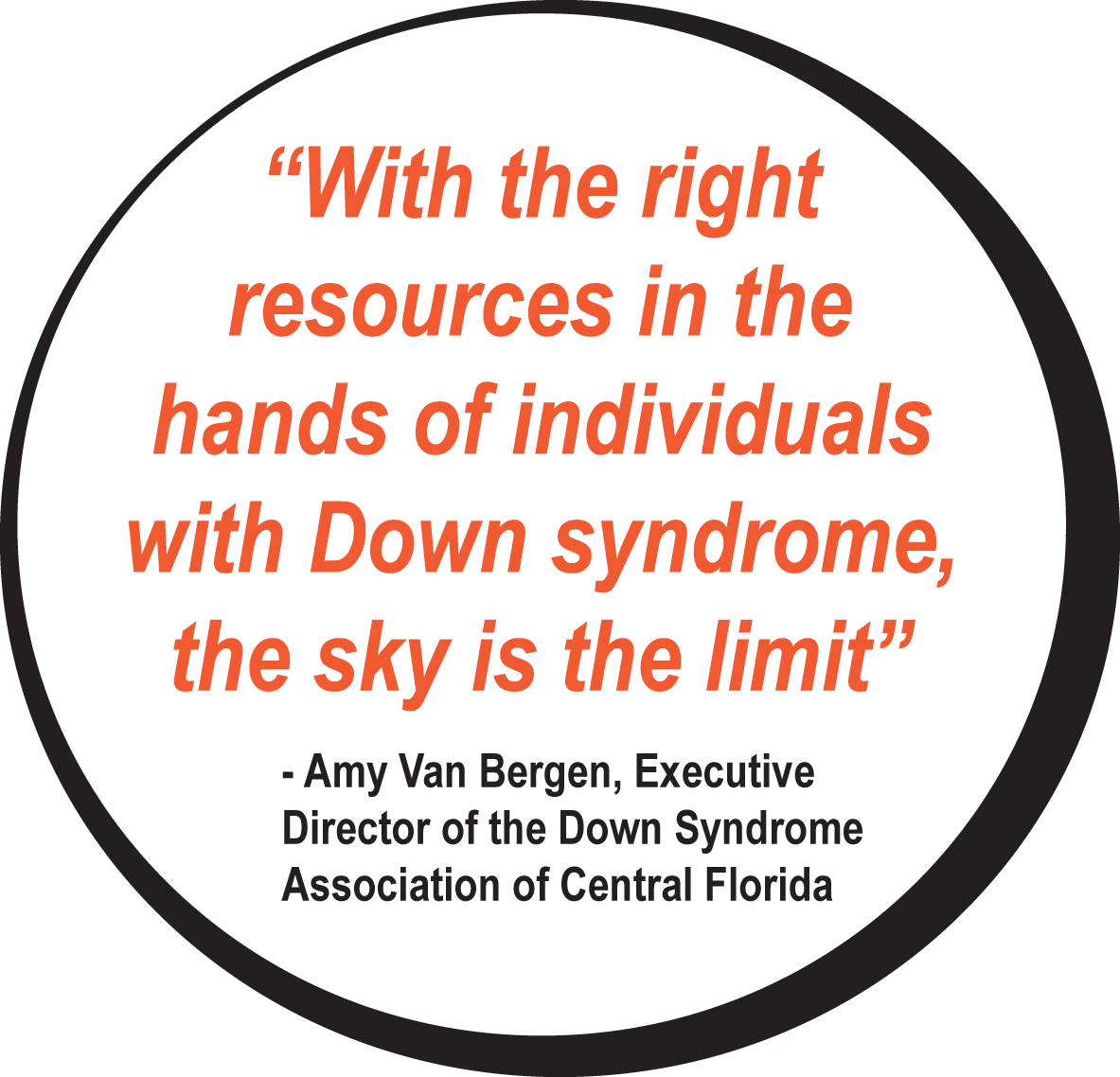
“The Grant helps us increase educational programming in undeserved rural areas,” said Amy Van Bergen, Executive Director of DSAF. “We’ve also begun a new course to help teach reading and other academic skills to adults with Down syndrome.” Plans are in motion to re-create the adult education track throughout the area and develop a toolkit that will allow smaller organizations to implement similar programs at little to no cost.
To donate, volunteer or learn more about DSACF, visit dsacf.org or call 407-478-5621
 Experience our inspirational and groundbreaking videos and photos. Our children and self-advocates are beautiful AND brilliant!
 Make sure your local Representatives are on the Congressional Down Syndrome Task Force.
Keep up with research news, upcoming programs, events and educational conferences.
Find us online here: