

Global Down Syndrome Foundation Raises Record $2 Million
October 29th, 2015 by Global Down Syndrome Foundation
Global teams up with Alzheimer’s Association
January 2nd, 2015 by Global Down Syndrome Foundation
Awarding a total of $2.2 mil in Down syndrome-Alzheimer’s research grants. Samuel L. Jackson shares how his family has been affected by the disease
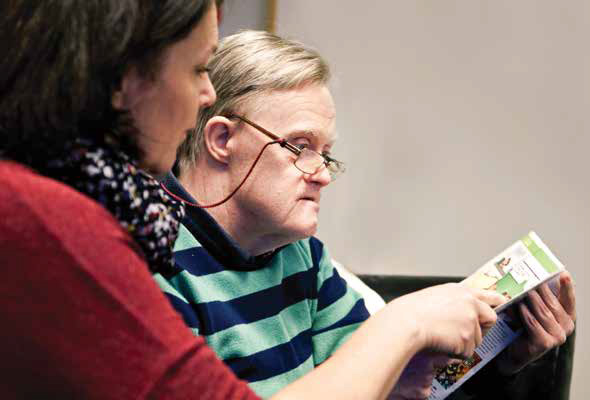
For the second year in a row, Global Down Syndrome Foundation, the Alzheimer’s Association and the Linda Crnic Institute for Down Syndrome are teaming up to to better understand the development of Alzheimer’s disease in individuals with Down syndrome and translate the research into improved treatments for people at risk to develop Alzheimer’s.
The organizations are supporting this growing area of study through a joint grant initiative called “Understanding the Development and Devising Treatments for Alzheimer’s Disease in Individuals with Down Syndrome.”
Why Down syndrome-Alzheimer’s disease research is important
One in eight older Americans suffers from Alzheimer’s disease, and 5.4 million Americans have Alzheimer’s today, with an estimated 13 million by 2050. One hundred percent of people with Down syndrome have the brain pathology of Alzheimer’s disease, and an estimated 50 percent will develop the symptoms before age 50. Recognizing that these conditions are “two sides of the same coin” and studying them together will hasten the development of new treatments for both.
The effects of Alzheimer’s are well-known, but it’s the personal stories that really make an impact. In a magazine article and video with the Hollywood Reporter, film megastar Samuel L. Jackson talks about his family’s “heartbreaking” struggle with Alzheimer’s. Read more at www.hollywoodreporter.com/news/samuel-l-jackson-opens-up-725419 and watch the video below.
2015 Research Grants
Global and the Alzheimer’s Association have already awarded $1.2 million in research grants to scientists around the world studying the connection between Down syndrome and Alzheimer’s disease, and a second round of grants, totaling $1 million, will be announced soon.
Previous Research Grants Awardees and Their Projects
In response to a Request for Application, more than 50 applications from around the world were received and vetted by the extensive peer review system at the Alzheimer’s Association with input from the Crnic Institute. The process resulted in five grants, including:
Three grants for senior investigators, each totaling $300,000:
- Investigator: Dr. Huaxi Xu, Sanford-Burnham Medical Research Institute, La Jolla, CA
Title: Roles of miR-155/C/EBPß/SNX27 pathway in Alzheimer’s disease/DS
- Investigator: Dr. Ann-Charlotte Granholm, Medical University of South Carolina, Charleston, SC
Title: Brain-derived neurotropic factor and executive dysfunction in DS
- Investigator: Dr. Karen Chang, University of Southern California, Los Angeles, CA
Title: Functional protein interactions in Alzheimer’s disease and DS
Two grants for new investigators, each totaling $150,000:
- Investigator: Dr. Donna Wilcock, University of Kentucky Research Foundation, Lexington, KY
Title: Inflammatory biomarkers to predict transition to dementia in DS
- Investigator: Dr. Eitan Okun, Bar-Ilan University, Ramat-Gan, Israel
Title: Developing a DNA vaccine for Alzheimer’s disease in patients with DS
NIH DS-Connect registry unites Down syndrome community
December 2nd, 2014 by Global Down Syndrome Foundation
DS-Connect promises a path to research breakthroughs. If you are a parent or a guardian, help your loved one with Down syndrome and sign up now.
Sign up for DS-Connect today!
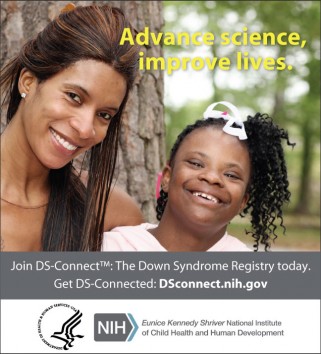
DS-Connect™: The Down Syndrome Registry is a vital new resource for people with Down syndrome, giving thousands of individuals access to a community of researchers working to improve their health and well-being.
Launched by the National Institutes of Health (NIH), the registry was first conceived in 2007 as part of the NIH’s 10-year Research Plan on Down Syndrome. Now that it has launched, DS-Connect provides a way for individuals with Down syndrome and their families to learn about, and take part in, research studies focused on related conditions such as developmental delays and congenital heart defects.
Global Down Syndrome Foundation helps lay the groundwork
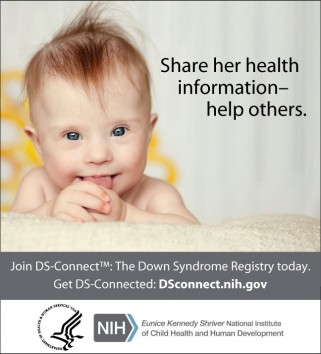 The registry began to take shape in December 2010, when Global and the Eunice Kennedy Shriver National Institute of Child Health and Human Development (NICHD) at the NIH co-hosted the first “Down Syndrome: National Conference on Patient Registries, Research Databases and Biobanks.”
During that meeting, 70 representatives from Global, the Linda Crnic Institute for Down Syndrome, NICHD, NIH, the Centers for Disease Control and Prevention, and other non-governmental organizations met to discuss the issues and implications of creating a such patient database.
“We wanted to create tools that would facilitate research for Down syndrome,” said Melissa Parisi, M.D., Ph.D., Chief of the Intellectual and Developmental Disabilities Branch at the NICHD. “NIH and Global worked together to identify leaders in the Down syndrome community who could help with next steps in the creation of the registry.”
The conference addressed a number of crucial issues related to the creation of an online patient database, including confidentiality concerns and short-, mid- and long-term goals. The launch of the registry is the ultimate successful outcome, and thus far, over 2,000 individuals with Down syndrome have registered.
Elevating Down syndrome research to new heights

Dr. Melissa Parisi
“This is the first time the Down syndrome community has had a resource that involves active participation in medical research,” Dr. Parisi said. “DS-Connect is designed to connect them with scientists working to better understand the condition and develop treatments that will help improve their quality of life.”
People with Down syndrome are living longer now than ever before, so it has become crucial to understand the health problems within the community and how to best treat those problems.
The secure, confidential database does more than link researchers with potential study subjects, however. Families are able to access lists of specialists, such as healthcare providers with experience treating children with Down syndrome, as well as educational resources that enable them to learn more about various conditions, such as Alzheimer’s.
“This is an opportunity for these families to learn about Down syndrome, not only for their own child, but also for the broader community,” Dr. Parisi said. “But it’s also about the research community giving back.”
 Experience our inspirational and groundbreaking videos and photos. Our children and self-advocates are beautiful AND brilliant!
 Make sure your local Representatives are on the Congressional Down Syndrome Task Force.
Keep up with research news, upcoming programs, events and educational conferences.
Find us online here: