AcceptAbility Slider
March 24th, 2018 by Global Down Syndrome Foundation
Light the Way 2018
March 22nd, 2018 by Global Down Syndrome Foundation

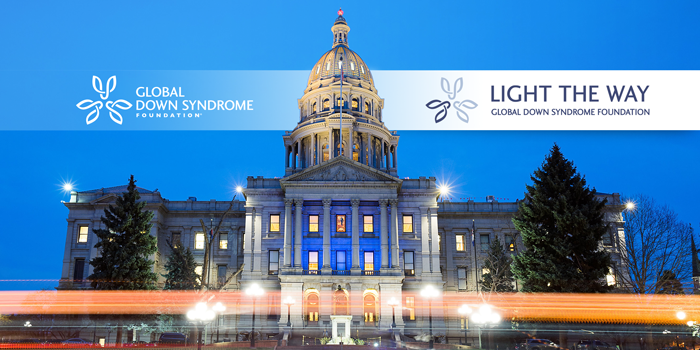
Global is so grateful to First Lady Valerie Sununu of New Hampshire and First Lady Robin Hickenlooper of Colorado for chairing the Light the Way Campaign, an initiative started in 2011 by First Lady Mary Pat Christie of New Jersey to shine a light on the groundbreaking advances being made to empower individuals with Down syndrome! We are honored to have partnered with First lady Sununu and First Lady Hickenlooper to highlight Global’s initiatives that are making a difference for people with Down syndrome throughout the country.
On the evening of Wednesday, March 21st as part of the Light the Way campaign, New Hampshire and Colorado lit the Governor’s Residences in blue in recognition of Down syndrome research. This date has particular significance as Down syndrome results from the presence of three copies of chromosome 21. Below are all the participating states from 2018!
Colorado
New Hampshire
New Jersey
North Carolina
Oklahoma
Virginia
Wyoming
Minnesota
New Mexico
Ohio
Tennessee
Texas
West Virginia
Arkansas
Indiana
Pennsylvania
Illinois
Kansas
Maryland
Wisconsin
Montana
Puerto Rico
Yesterday & Today: World Down Syndrome Day 2018
March 13th, 2018 by Global Down Syndrome Foundation
Global Down Syndrome Foundation recognizes World Down Syndrome Day as a chance to reflect on the progress we have made, and on our hopes for the future.
![]() |
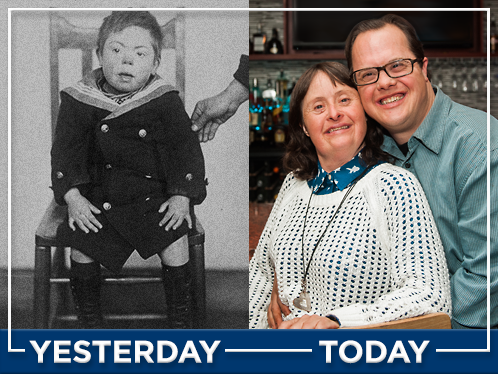
YESTERDAY: The life expectancy of a person with Down syndrome was only 28 years in the 1980s.
TODAY: Today in the US, the life expectancy is nearly 60 years!
The discrimination against people with Down syndrome can be profound. Children and adults with the condition are still deprived of lifesaving medical care. There are also too few medical professionals who understand that patients with Down syndrome are highly predisposed to certain diseases and highly protected from others.
At Global we are working to continue this significant increase of lifespan for people with Down syndrome through improved medical care.
![]() |
YESTERDAY: In the US, people with Down syndrome weren’t allowed to attend public schools until the 1970s.
TODAY: Students with special needs get a free and appropriate public education required by law.
Despite many advances since the 1970s, so many parents are still battling the education system to enforce their rights. At the same time they are trying to unlock how their children and adults with Down syndrome can learn better.
At Global we are working to help ensure improved health outcomes (including in sleep, speech, hearing and vision) that we believe will allow students with Down syndrome to reach their true potential.
![]() |
YESTERDAY: In the US, the accepted terminology for people with Down syndrome used to be “mongoloid” and “mentally retarded.”
TODAY: Thanks to Rosa’s Law, “mental retardation” was replaced with “intellectual and developmental disabilities” in all federal documents.
We believe in freedom of speech. But we also believe that our community must demand respect through language, and stand up to those who would bully us with words. Through our training and our advocacy we educate medical and research professionals in “people first” language and we have stood up to bullies using the “R” word and worse.
At Global we are advocating for equality and respect in Washington, D.C. and throughout the world.
![]() |
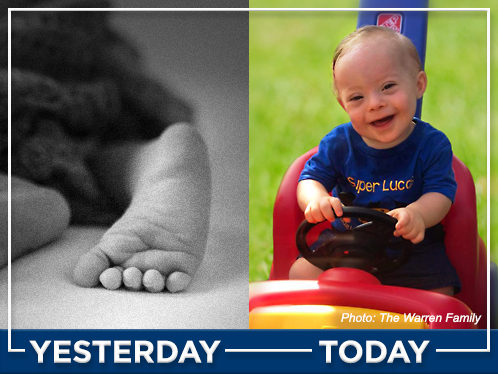
YESTERDAY: In U.S. hospitals, starving a baby to death with Down syndrome, or another intellectual disability, was allowed until the 1981 passing of the “Baby Doe Law.”
TODAY: This year we are celebrating Lucas Warren as the “healthy, happy, perfect” 2018 Gerber Spokesbaby – Lucas happens to have Down syndrome!
In Iceland, Denmark and other countries where the government boasts a “Down syndrome-free” future, the eugenics framework is marked and frightening. Standing on the shoulders of our human and civil rights predecessors of the 1960s and 1970s, we must be vigilant to ensure that our children and adults have rights, and are valued, equal citizens – in the U.S. and abroad.
Global advocates for our government to invest in people with Down syndrome and for people with the condition to be recognized throughout the world.
![]() |
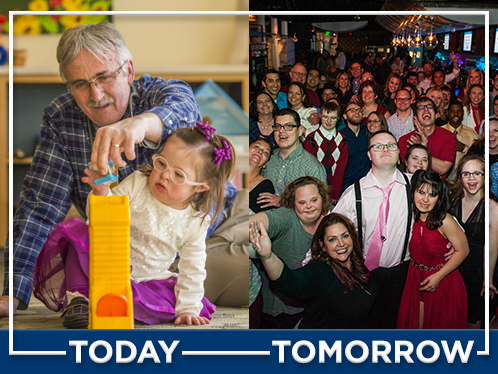
TODAY: The Sie Center for Down Syndrome at Children’s Hospital Colorado provides life-saving and life-changing medical care to over 1,400 children with Down syndrome.
TOMORROW: Global envisions a world where we are able to establish a network of pediatric AND adult medical centers providing EXCELLENT care to millions of people with Down syndrome!
On this World Down Syndrome Day, Global is grateful for the amazing progress we have made together—we have created a pipeline of excellent science that informs our excellent medical care benefitting thousands of people with Down syndrome.
To be sustainable and to GROW so as to help ever more people with Down syndrome, we are grateful to you for your on-going support and trust in us to make a positive, tangible difference.
THANK YOU for allowing us to save and improve lives. Happy World Down Syndrome Day!!
Global interview emphasizes increased lifespan and the urgent need for NIH funding
March 5th, 2018 by Global Down Syndrome Foundation
Limited tickets still available! Join Global on February 24 at the Gothic Theatre for an amazing show!
February 20th, 2018 by Global Down Syndrome Foundation
President & CEO, Michelle Sie Whitten reflects upon & celebrates first Gerber Baby with Down syndrome
February 9th, 2018 by Global Down Syndrome Foundation
As the head of Global Down Syndrome Foundation and as the mother of a 14-year old with Down syndrome, I believe I speak on behalf of a large community when I say I am thrilled and deeply appreciative that Lucas Warren has been selected as the 2018 Gerber Spokesbaby! To be chosen from 140,000 other contestants is truly remarkable – all the more so because Lucas happens to have Down syndrome.
While the human and civil rights movement of the 1960s and 1970s have afforded us many gains, there is still widespread discrimination against people with Down syndrome (for example in schools and medical practices), primarily due to lack of education. To have Lucas be the Gerber Spokesbaby for the entire year is a huge step towards awareness and inclusion.
In the U.S. we can proudly point to ethnic and gender diversity, but we still have a ways to go in promoting the differently-abled. Sesame Street was perhaps first with a child in a wheelchair being featured. Today we can thank OshKosh, Target, Babies “R” Us, Old Navy, Kmart and other stores for highlighting the differently-abled, including models with Down syndrome in their advertisements.
The Gerber Baby choice is perhaps even more meaningful since the historic marketing emphasizes the “perfect baby.” An aspiration for what all parents presumably want – a baby that is beautiful, healthy, and happy. By choosing Lucas, I believe the message is that babies with Down syndrome are no different from typical babies and can be seen as adorably perfect.
Everyone at the Global office was bouncing off the walls today for this small, but important victory in awareness. We congratulate the Warren family and Gerber, and we look forward to supporting all of Lucas’ efforts throughout 2018 as “the” Gerber Spokesbaby.
![]() |
Gerber’s new ‘spokesbaby’ has Denver Down syndrome charity buzzing
Lucas Warren became the first Gerber Baby with Down Syndrome. And at a Denver charity, it couldn’t be more ecstatic. |
![]() |
In a first, Gerber names boy with Down syndrome ‘Spokesbaby’
An 18-month-old boy with Down syndrome has been named by baby food maker Gerber as its “Spokesbaby” for 2018, the company said on Wednesday, an action hailed by advocates for people with the genetic condition. |
Global Down Syndrome Foundation announces roster of authors committed to establishing Medical Care Guidelines for Adults with Down syndrome
February 8th, 2018 by Global Down Syndrome Foundation
New guidelines aim to address different standards of care and the doubling of life expectancy for individuals with Down syndrome.
DENVER | The Global Down Syndrome Foundation announced today the full roster of authors committed to establishing new medical care guidelines for adults with Down syndrome (“Guidelines”). The Guidelines will draw and build upon previous, important work in the field.
“We are pleased and deeply honored to have such an esteemed group of medical practitioners to help launch this much-needed initiative,” said Michelle Sie Whitten, President & CEO of Global Down Syndrome Foundation. “Because of the dramatically different disease spectrum of people with Down syndrome and their ever-increasing life expectancy, it is critical to update and disseminate best care practices for aging adults with Down syndrome.”
People with Down syndrome are born with three copies of chromosome 21 instead of two, which causes them to be highly predisposed to some diseases that tend to manifest in aging populations (e.g. Alzheimer’s disease, autoimmune disorders). Yet they remain highly protected from other diseases (e.g. breast cancer, heart attacks and strokes). Many such diseases manifest in aging populations.
In the U.S., the life expectancy of an individual with Down syndrome has more than doubled in the last three decades, from 25 years in 1983 to 60 years today. The most recent guidelines for adults with Down syndrome were published in 2001 and the years since have been marked by many advancements in the general medical field and important findings specific to the care of adults with Down syndrome.
“I have had the privilege of serving hundreds of adults with Down syndrome and their families,” said Dr. George Capone, research scientist and director of the Down Syndrome Clinic and Research Center (DSCRC) at Kennedy Krieger Institute and associate professor of pediatrics at the Johns Hopkins University School of Medicine. “To be able to utilize my twenty-seven years of medical experience to inform these guidelines is extremely rewarding – and a lot of hard work. We are grateful to Global for helping us fund this, and, equally important, for committing to fund future guideline revisions every five years.”
The team of lead authors collaborating on the Guidelines includes both medical and behavioral experts in adult Down syndrome care representing many of the foremost medical clinics serving the unique needs of this population from across the United States. Authors committed to collaborating with Global’s Medical Care Guidelines for Adults with Down Syndrome are (in alphabetical order):
Lead Authors
- George Capone (MD)- Director of Down Syndrome Clinic and Research Center, Kennedy Krieger Institute, Associate Professor, John Hopkins School of Medicine, Baltimore, Maryland
- Brian Chicoine (MD)- Medical Director, Advocate Medical Group Adult Down Syndrome Center, Park Ridge, Illinois
- Barry Martin (MD)- Assistant Professor, Division of General Internal Medicine, University of Colorado School of Medicine,, Former Medical Director of the Denver Adult Down Syndrome Clinic, Denver, Colorado
- Dennis McGuire (PhD, LCSW)- Behavioral Expert for Adults with Down syndrome, Global Senior Consultant, former Director of Psychosocial Services, Adult Down Syndrome Clinic, Advocate Lutheran General Hospital, Park Ridge, Illinois
- Kent McKelvey (MD)- Director of Adult and Cancer Genetics Services, University of Arkansas for Medical Sciences, Director of Winthrop P. Rockefeller Multidisciplinary Clinic for Adults with Down syndrome, Little Rock, Arkansas
- Moya Peterson, (PhD, APRN)- Director of Adults with Down Syndrome Specialty Clinic, University of Kansas Medical Center, Kansas City, Kansas
- Carl Tyler (MD, MSc, ABFP, CAQ-Geriatrics)- Director of the Developmental Disabilities – Practice-Based Research Network (DD-PBRN), Practitioner at the Cleveland Clinic, Specializes in geriatrics and adults with I/DD, Cleveland, Ohio
Co-Authors
- Peter Bulova (MD)- Director of University of Pittsburgh Adult Down Syndrome Center, Pittsburgh, Pennsylvania
- Bryn Gelaro (LSW)- Director of Adult Initiatives and Special Projects, Global Down Syndrome Foundation, Denver, Colorado
- Michael Wells (BS)- Research Coordinator for the Developmental Disabilities – Practice-Based Research Network (DD-PBRN), Cleveland, Ohio
The authors will work with Global and ECRI Institute, a non-profit group of statisticians and PhDs specializing in guideline creation, to produce a set of guidelines by the end of 2019. The collaborators hope to have the Guidelines published in medical journals and have committed to ensuring the Guidelines be accessible and free-of-cost to self-advocates, physicians, family members, caretakers, Down syndrome organizations, and others who would benefit from such Guidelines.
“Creating adult guidelines is intimidating because of their importance and because we realize data is likely sparse in certain areas but we are excited to take on the challenge and build this,” said Kent McKelvey, M.D., Associate Professor and Director of Adult and Cancer Genetics Services at University of Arkansas for Medical Sciences. “With this project, we will systematically gather data and then have opportunity to debate and apply decades of combined clinical experience in Down syndrome care to provide educated guidance. We must acknowledge the gaps found and then embrace the need for more research. We must eventually get a playbook into the hands of parents and medical professionals to improve the physical and mental health of with Down syndrome.”
Global has committed to translating the Guidelines into multiple languages and to updating the Guidelines every five years. To date, 36 different local Down syndrome organizations and over 50 individuals have provided and pledged financial support towards the Guidelines, with the rest of the funding being provided by Global Down Syndrome Foundation.
###
About the Global Down Syndrome Foundation
The Global Down Syndrome Foundation is at the forefront of research, medical care, education and advocacy dedicated to significantly improving the lives of people with Down syndrome. Supporting the research of hundreds of scientists around the world, and through our advocates, partners, and affiliates including the Linda Crnic Institute for Down Syndrome and the Anna and John J. Sie Center for Down Syndrome, Global is making an impact on the lives of people with Down syndrome today, and remains focused on finding solutions tomorrow. We are committed to helping people with Down syndrome realize their fullest potential and to lead healthy and productive lives. To learn more, visit www.globaldownsyndrome.org.
Global’s New Headquarters featured on 9News & CBS
January 31st, 2018 by Global Down Syndrome Foundation
Frank Stephens at DC Hearing
January 19th, 2018 by Global Down Syndrome Foundation
Hallmark’s “Home & Family” interviews Ambassador DeOndra Dixon & Global’s Michelle Sie Whitten
January 16th, 2018 by Global Down Syndrome Foundation


Experience our inspirational and groundbreaking videos and photos. Our children and self-advocates are beautiful AND brilliant!
Make sure your local Representatives are on the Congressional Down Syndrome Task Force.