Archive for the ‘Blog’ Category

Bipartisan Legislation for Transformative NIH Down Syndrome Research – A Legacy for GLOBAL Ambassador DeOndra Dixon

DENVER – May 22, 2025 — Sens. John Hickenlooper (D-CO) and Jerry Moran (R-KS) and Reps. Diana DeGette (D-CO) and Richard Hudson (R-NC) have reintroduced the DeOndra Dixon INCLUDE Project Act (S.1838/H.R. 3491). Joining as original cosponsors are Sens. Cory Booker (D-NJ) and Markwayne Mullin (R-OK) and Reps. Tom Cole (R-OK), Rosa DeLauro (D-CT), Pete Stauber (R-MN), and Eleanor Holmes Norton (D-DC).

The bill provides statutory authority for the trans-NIH INCLUDE “Investigation of Co-occurring Conditions Across the Lifespan to Understand Down Syndrome” Project. As a result of Global Down Syndrome Foundation’s advocacy, the INCLUDE Project was established in 2018 to investigate the co-occurring conditions that affect those with Down syndrome (e.g. Alzheimer’s, autoimmune disorders) and their quality-of-life needs.  It has focused on targeted research on chromosome 21, assembling a large study population of individuals with Down syndrome, and conducting clinical trials that include those with Down syndrome. 

“Hundreds of thousands of Americans live with Down syndrome, and yet its research has been underfunded for decades,” says Senator Hickenlooper. “This bill is named for my friend DeOndra Dixon, who lived a full, vibrant life and wanted the same for all people living with Down syndrome. We are determined to get this bill across the finish line for her, and for every American who will benefit from research on many different health conditions.” 

“Research, supported by the NIH, has helped improve and extend the lives of individuals with Down syndrome, but there is still more to learn,” says Senator Moran. “This legislation will invest in scientific studies on Down syndrome to help members of the Down syndrome community and their families find answers and solutions for the health challenges they face.”

“Down syndrome, the leading cause of developmental delay in the U.S. and worldwide, was the least funded genetic syndrome at the NIH for decades,” says Representative Diana DeGette.  “We have made tremendous strides in new federal investments in Down syndrome research to understand why those living with Down syndrome are so at risk for some diseases, such as Alzheimer’s and autoimmune disorders, and protected from other diseases such as solid tumor cancers. Passage of the DeOndra Dixon INCLUDE Project Act will ensure these successful trans-NIH initiatives continue to make significant scientific advances to improve and extend the lives of people with Down syndrome and millions of other Americans as well.”

“People with Down syndrome enrich our world in many unique ways,” says Representative Hudson. “The DeOndra Dixon INCLUDE Act ensures people with Down syndrome are valued, respected members of society and that NIH is supporting their health, enabling them to live their lives to their full potential – with no barriers or bias or obstacles standing in their way. I am honored to continue and grow research efforts so people with Down syndrome have the long and healthy lives they deserve.”

The legislation is named in honor of the life and legacy of DeOndra Dixon, beloved Global Down Syndrome Foundation (GLOBAL) Ambassador and sister of Academy Award-winning and Grammy Award-winning talent Jamie Foxx. DeOndra was an inspiration behind GLOBAL’s highest honor, the Quincy Jones Exceptional Advocacy Award and she traveled the world promoting awareness and advocacy. She was a talented dancer and musician who performed with her brother at the Grammy Awards.

“We are forever grateful to GLOBAL for creating such purpose for our little sister DeOndra,” says Jamie Foxx. “My sister Deidra and I are so proud of the big difference she made through her advocacy in DC, and now with this bill she will continue to make a difference. There isn’t a day that goes by that we don’t miss her, but today I know she’s dancing up in heaven because this legislation is named after her and will help millions of people with Down syndrome.”

“GLOBAL is truly overwhelmed by the strong bipartisan support for the DeOndra Dixon INCLUDE Project Act that will formally authorize the INCLUDE Project at the NIH and make the project more permanent,” says Michelle Sie Whitten, President and CEO of the Global Down Syndrome Foundation. “We couldn’t have come this far without the leadership of HELP Committee leaders Sens. John Hickenlooper and Markwayne Mullin, House Energy & Commerce leaders Reps. Richard Hudson and Diana DeGette, and our appropriation champions Reps. Tom Cole, Rosa DeLauro and Robert Aderholt. We also owe so much to Dr. Joaquin Espinosa for bringing scientific breakthroughs to the table, to Ambassador DeOndra’s beautiful family, and to our original congressional champions, especially those who have children with Down syndrome such as Reps Cathy McMorris Rodgers, Pete Stauber and Eleanor Holmes Norton.”

GLOBAL had advocated for a trans-National Institutes of Health (NIH) Down syndrome research program since its inception in 2009. In 2017, three GLOBAL leaders , including board member, Frank Stephens, testified at the hallmark House Appropriations Labor, Health and Human Services subcommittee hearing on Down syndrome research. Frank’s testimony went viral that evening with 1 million views and today has over 200 million views. Shortly after the hearing, GLOBAL’s long-time advocacy goal was fulfilled, and the NIH established the INCLUDE Project.

Since the INCLUDE Project was established in 2018, the program has funded 389 unique awards within 21 of the 27 NIH institutes investing $434M. Thirteen of these institutes did not participate in Down syndrome research prior to this program. The INCLUDE Project has also supported the development of the clinical trial infrastructure. Prior to the program, there were only two NIH clinical trials focused on people with Down syndrome. In just seven years, the INCLUDE Project has funded fourteen promising clinical trials with possible immediate or short-term impact for people with Down syndrome.

“DSA of Central Oklahoma is a long-time supporter of the Global Down Syndrome Foundation, and their government advocacy work that resulted in the establishment of the trans-NIH Down syndrome research program called the INCLUDE Project,” says Sarah Soell, Executive Director of the Down Syndrome Association of Central Oklahoma. “We know first-hand from our families that the increased research funding is making a difference. We see real progress in the treatment of the many co-occurring conditions that we see in people with Down syndrome, including autoimmune conditions, regression disorder, sleep apnea, Alzheimer’s and more. Given the nearly twenty years of Down syndrome being the least funded genetic condition at the NIH prior to the INCLUDE Project, it is so important to pass this bill!”

Formally authorizing the INCLUDE Project beyond an annual congressional directive will ensure that people with Down syndrome are not left behind when it comes to participating in clinical trials; it will improve health outcomes and improve their quality of life; and it will send a strong message that our society values and wants to invest in the future of our children and adults with Down syndrome and their families.

GLOBAL urges advocates to contact Congress to urge them to co-sponsor and support passage of the DeOndra Dixon INCLUDE Project Act: https://www.globaldownsyndrome.org/deondra-dixon-include-project-act/

GLOBAL Affiliate, the Crnic Institute for Down Syndrome, has multiple clinical trials specifically designed for persons with Down syndrome testing new therapies for Alzheimer’s disease in Down Syndrome, Down Syndrome Regression Disorder, and autoimmune conditions.

To read about the impactful research that the INCLUDE Project has funded visit the NIH Down Syndrome Coordinating Center Website at: https://includedcc.org/.

###

About Global Down Syndrome Foundation

The Global Down Syndrome Foundation (GLOBAL) is the largest non-profit in the U.S. working to save lives and dramatically improve health outcomes for people with Down syndrome. GLOBAL has donated more than $32 million to establish the first Down syndrome research institute supporting over 400 scientists and over 2,700 patients with Down syndrome from 33 states and 10 countries. Working closely with Congress and the National Institutes of Health, GLOBAL is the lead advocacy organization in the U.S. for Down syndrome research and care. GLOBAL has a membership of over 100 Down syndrome organizations worldwide, and is part of a network of Affiliates – the Crnic Institute for Down Syndrome, the Sie Center for Down Syndrome, and the University of Colorado Alzheimer’s and Cognition Center – all on the Anschutz Medical Campus. 

GLOBAL’s widely circulated medical publications include Global Medical Care Guidelines for Adults with Down Syndrome, Prenatal & Newborn Down Syndrome Information and the award-winning magazine Down Syndrome WorldTM . GLOBAL also organizes the annual AcceptAbility Gala in Washington DC, and the annual Be Beautiful Be Yourself Fashion Show, the largest Down syndrome fundraiser in the world. Visit globaldownsyndrome.org and follow us on social media (Facebook & Twitter: @GDSFoundation, Instagram: @globaldownsyndrome). 

## end ##

GLOBAL Webinar with DS-Connect 2025

May 21st, 2025 by Global Down Syndrome Foundation

Recap of the DS-Connect and GLOBAL Webinar 


On May 6th, GLOBAL and DS-Connect hosted two important webinars in English and Spanish with over 150 attendees!

In the pivotal webinar (in English and Spanish) co-hosted by the Global Down Syndrome Foundation and DS-Connect, Dr. Joaquín Espinosa, Executive Director of the Linda Crnic Institute for Down Syndrome, dove into the newly enhanced DS-Connect®: The Down Syndrome Registry. This upgraded platform aims to empower individuals with Down syndrome and their families to contribute valuable health information, thereby accelerating research and improving health outcomes. Dr. Espinosa emphasized that participation is voluntary and confidential, providing a secure environment for sharing health data. He also highlighted the importance of this registry in connecting participants with research opportunities and clinical studies. This webinar underscored how collective contributions can lead to a deeper understanding of Down syndrome and inform better healthcare practices.  He gave a demonstration on just how user friendly the system is.  To learn more and sign up, please, click here.


English Presentation: Click Here

Video de la Presentación: Haga click aquí 


Joaquín Espinosa, PhD, is the Executive Director for Science at the Linda Crnic Institute for Down Syndrome. He is also a Professor in the Department of Pharmacology at the University of Colorado Denver School of Medicine and the founding Director of the Functional Genomics Facility at the University of Colorado. Under Dr. Espinosa’s leadership and in collaboration with the Global Down Syndrome Foundation, the Crnic Institute’s Human Trisome Project was launched and has become one of the largest cohort studies of people with Down syndrome to date. In addition, his team is leading clinical trials testing immunomodulatory therapies for autoimmune conditions, Down syndrome Regression Disorder, and improved early neurodevelopment. He also serves as the Leader of the Administrative and Outreach Core of the INCLUDE Data Coordinating Center, an NIH-funded resource aiming to accelerate discoveries by facilitating access to and analysis of large scale datasets form cohort studies of the population with Down syndrome.


Important Notice: GLOBAL Down Syndrome Foundation employees and/or volunteers DO NOT act as your medical professional or attorney. Responses you receive by email, telephone, or in any other manner DO NOT create or constitute a physician-patient or attorney-client relationship between you and GLOBAL Down Syndrome Foundation (GLOBAL), or any employee or other person associated with GLOBAL.

Information received from GLOBAL employees or volunteers, or from this website, should NOT be considered a substitute for the advice of a medical professional or attorney. GLOBAL DOES NOT provide any medical or legal advice. You should consult your own physician or attorney for medical or legal advice. This website is a general service providing information via the Internet. The information contained on this website is general information and should not be construed as medical advice to be applied to specific factual situations.


United Coalition for Down Syndrome Condemns the Rise in the Use of the R-word

May 13th, 2025 by Global Down Syndrome Foundation

Freedom of Speech & Protecting Vulnerable Communities Are Not Mutually Exclusive   

CINCINNATI, DENVER, HOFFMAN ESTATES, Ill., WASHINGTON, D.C., WOBURN, Mass. (May 1, 2025) – Today, the United Coalition for Down Syndrome is speaking out against the alarming resurgence of the “R-word” in public discourse. At the same time, we are calling on individuals and organizations to take a stand, by pledging not to use this harmful slur.

Numerous media outlets have reported a sharp increase in the word’s usage across television, radio, podcasts, social media, and the internet. A recent study examining social media in January 2025 revealed a staggering 207.5% rise in posts containing the R-word on X alone – totaling 312,642 instances.

Shockingly, there are some who believe its use is a “great cultural victory.”

We firmly reject that notion. The R-word is not a cultural triumph – it is a tool of marginalization. It dehumanizes people with Down syndrome and other disabilities and can contribute to mental distress and long-lasting harm. This type of language is rooted in the same prejudice that, for decades, led to people with Down syndrome and other intellectual and developmental disabilities being placed in cruel and inhumane institutions such as Willowbrook, NY –  a practice that continued well into the early 1990s.

“Being compared to people like me should be considered a badge of honor. No one overcomes more than we do and still loves life so much. And yet here we are in 2025 with some of the most influential people in our country, like naughty little boys with their first curse word, reviving the use of the R-word just to gain attention and, meanwhile, opening the floodgates to its popular use. I appreciate the United Coalition for Down Syndrome standing up for what is right, and I hope this goes a long way in educating people that using the R-word is like a little dagger jabbing at our dignity as human beings,” says Frank Stephens, a Special Olympics Global Messenger associated with the “End the Word” campaign, and Global Down Syndrome Foundation board member.

The United Coalition for Down Syndrome embraces and is grateful for the freedom of speech that defines our nation. But using that freedom to perpetuate a derogatory term aimed at one of society’s most vulnerable populations is not bold – it’s cowardly. Not everyone with an intellectual and developmental disability can push back against such slurs or exact any meaningful social cost on those who use them.

We believe that the overwhelming majority of Americans want to do the right thing. The United Coalition for Down Syndrome urges everyone to make the conscious choice to leave this word behind. In exercising our freedom of speech, let’s also choose compassion, dignity, and respect. These are lives worth celebrating – and our language should reflect that truth.

Related Resources:

GiGi’s Playhouse Down Syndrome Achievement Centers: Community Page; GiGi’s Message on the R Word  
Global Down Syndrome Foundation: Words Can Hurt

National Down Syndrome Congress: NDSC condemns the use of the “R-word” and calls for respectful language

National Down Syndrome Society: Preferred Language Guide; R-Word TikTok Video

Special Olympics: Why the R-word is the R-Slur; Increase Usage of the R-word on Social Media

About the United Coalition for Down Syndrome
The United Coalition for Down Syndrome (UCDS) is a coalition of national Down syndrome organizations seeking to facilitate collective action and speak with a unified voice concerning critical issues that impact the Down syndrome community in the United States. UCDS is comprised of the following national organizations: GiGi’s Playhouse Achievement Centers, Global Down Syndrome Foundation, LuMind IDSC, National Down Syndrome Congress, and National Down Syndrome Society. All of our organizations remain steadfastly non-partisan, focusing solely on the well-being of individuals with Down syndrome and their families.

GLOBAL Members Taking a Stand:

Contacts:

Anca Elena Call                                                                            
Global Down Syndrome Foundation        
acall@globaldownsyndrome.org                                          
C: (720) 320-3832           

Jim Hudson                                                                
National Down Syndrome Congress
jim@ndsccenter.org
C: (513) 400-6563

Michelle Sagan
National Down Syndrome Society
msagan@ndss.org
C: (301) 728-0447

Kris Meadows
GiGi’s Playhouse
Kmeadows@gigisplayhouse.org
C: (815) 739-7656

Kate O’Neill
LuMind IDSC
koneill@lumindidsc.org
C: (508) 344-4932


Event Honors Rep. DeGette, Rep. Aderholt, and Tucker Emry & Features Chuck Todd, and Performers with Down Syndrome

WHAT

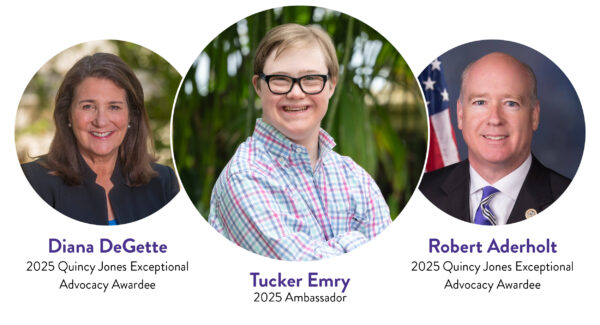
The Global Down Syndrome Foundation (GLOBAL) is honoring Congresswoman Diana DeGette (D-CO) and Congressman Robert Aderholt (R-AL), who will receive GLOBAL’s highest honor,the Quincy Jones Exceptional Advocacy Awards, for their work in support for those with Down syndrome, during its annual AcceptAbility Gala. GLOBAL Ambassador Tucker Emry, an actor and self-advocate from Baltimore, will also be recognized. The gala is an inspiring fundraiser that features a dance performance by Annapolis’ Robert Wallop and other DC-area dancers from the inclusive dance team, RhythmXpress, as well as a performance by Multiplatinum Artist and Actor Phillip Phillips. This year’s gala is honoring the memory of the beloved and long-time GLOBAL supporter, Cornelia Stephens.

WHEN

Wednesday, May 21, 2025; 6:00 p.m. – Reception/Red Carpet; 7:00 p.m. – Dinner, live auction and special performances by Phillip Phillips and local talent with Down syndrome and other intellectual disabilities.

WHO

  • Honoree Cong. Robert Aderholt (R-AL)
  • Honoree Cong. Diana DeGette (D-CO)
  • 2025 GLOBAL Ambassador Tucker Emry, Actor and Self-Advocate from Baltimore
  • Congressional Host Committee Members: Sen. Cory Booker, Cong. Katherine Clark, Cong. Tom Cole, Sen. Steve Daines, Cong. Rosa DeLauro, Cong. Lois Frankel, Sen. John Hickenlooper, Cong. Richard Hudson (presenting), Sen. Jerry Moran, Cong. Eleanor Holmes Norton, Cong. Pete Sessions, Cong. Pete Stauber
  • Phillip Phillips, Multiplatinum Artist and Actor
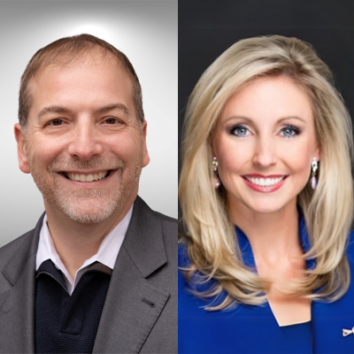
  • Chuck Todd, NBC News’ chief political analyst, Event Co-Emcee
  • Autria Godfrey, former ABC7 News anchor, Event Co-Emcee
  • Robert Wallop, Soloist Dancer and Self-Advocate, Annapolis, MD
  • RhythmXpress, Integrated Dance Team, Annapolis, MD
  • Michelle Sie Whitten, President & CEO, Global Down Syndrome Foundation
  • Frank Stephens, GLOBAL Board Member, GLOBAL Ambassador, Self-Advocate and Actor, Fairfax, VA
  • David Egan, Quincy Jones Awardee, Gala Event Committee, Self-Advocate and Author, Vienna, VA
  • Natalie Farr Harrison, SVP, Government Relations, Avoq, and Guy Harrison, Partner, OnMessage, of Alexandria, VA, Gala Board Co-Chairs

WHERE

Marriott Marquis Washington, DC
901 Massachusetts Ave, NW
Washington, DC 20001

WHY

GLOBAL’s annual AcceptAbility Gala brings together policymakers from both sides of the aisle, key scientists from NIH, philanthropists, corporate sponsors, and the Down syndrome community. Down syndrome is the most frequent chromosomal condition, affecting over 400,000 Americans. With GLOBAL’s leadership bringing together multiple stakeholders, the NIH Down syndrome research and medical care budget has increased by $418 million over the last seven years. The AcceptAbility Gala is an opportunity to celebrate major new federal research funding increases after years of being one of the least funded genetic conditions and to educate Congress and the community about the transformative DeOndra Dixon INCLUDE Project Act of 2024 that will elongate life and improve health outcomes for people with Down syndrome.

HOW

To cover the event or receive photos, contact Shawn Flaherty at 703-554-3609. For more information, visit www.globaldownsyndrome.org. 

Global Down Syndrome Foundation – Policy Statement

DENVER (May 6, 2025) – Today the Global Down Syndrome Foundation published its Policy Statement on how potential changes to Medicaid can affect individuals with Down syndrome and their families and issued a call to action.

Congress and the Administration are considering changes to the Medicaid program, a shared federal-state program that provides health insurance coverage, medical care and services for low-income Americans, as well as Americans with disabilities, including those with Down syndrome. While income eligibility limits vary by state, individuals with incomes from $967/month to $2,901/month can qualify for Medicaid coverage and services.   

As policymakers debate and consider changes to this vital program, the Global Down Syndrome Foundation (GLOBAL) urges Congress to safeguard and strengthen the Medicaid program, recognizing its indispensable role in supporting individuals with Down syndrome and others with intellectual and developmental disabilities. 

Background

Down syndrome is a chromosomal condition caused by having an extra copy of chromosome 21.  It is the most common chromosomal condition diagnosed in the U.S., affecting about 6,000 babies born every year. Americans with Down syndrome often have complex medical needs. While it is important to note that people with Down syndrome are genetically protected from certain diseases such as solid tumor cancers and certain types of heart attack and stroke, unfortunately they are also more at risk for other diseases. For example, they are at a higher risk for diseases such as Alzheimer’s disease, leukemias, autoimmune diseases such as hypothyroidism and alopecia areata, congenital heart disease, and sleep apnea.

Medicaid is the primary source of health coverage for individuals with Down syndrome, providing critical medical, long-term services, and home and community-based support. A 2023 study published in JAMA Health Forum, Medicaid Enrollment and Service Use Among Adults With Down Syndrome, which studied enrollment patterns, identified 123,024 with Down syndrome, over 25% of the Down syndrome population, enrolled in Medicaid between 2011 and 2019. While Medicaid coverage eligibility is based on household income relative to the federal poverty level, people with disabilities such as Down syndrome can qualify for Medicaid coverage through the Social Security Administration’s Supplemental Security Income (SSI) benefits program. To qualify, individuals must have a medically determinable physical or mental impairment that prevents substantial gainful activity and is expected to last at least 12 months or result in death, and meet certain monthly income and asset limits. 

The Importance of Medicaid Coverage

Medicaid provides coverage that supports the unique needs and health challenges facing people with Down syndrome, including: 

  • Home and Community-Based Services (HCBS): Supports independent living and prevents unnecessary institutionalization.
  • Specialty Medical Care: Covers treatment for co-occurring conditions common among people with Down syndrome, including congenital heart defects, thyroid disease, hearing loss, vision impairment, sleep apnea, gastrointestinal conditions, and autoimmune disorders.
  • Therapy Services: Funds physical, occupational, and speech therapies that promote functional independence and quality of life.
  • Personal Care Support: Assists with activities of daily living, including bathing, dressing, and eating.
  • Behavioral Health Services: Supports mental health care and behavioral interventions for individuals with intellectual and developmental disabilities.
  • Medical Equipment and Supplies: Provides access to durable medical equipment like hearing aids, orthotics, wheelchairs, and communication devices.

A Call To Action

GLOBAL supports efforts to improve the Medicaid program. However, we have deep concerns regarding proposals under consideration to significantly reduce federal funding, impose block grants that would diminish funding, and enact onerous eligibility restrictions that would result in people with Down syndrome being denied coverage or reducing current coverage for essential services.  Protecting Medicaid is not just fiscally responsible — it is a moral obligation to ensure that individuals with Down syndrome and others with IDD can lead full, meaningful lives with the care and support they deserve. GLOBAL urges the Congress and Administration to protect Medicaid to ensure that people with Down syndrome and other vulnerable populations continue to have access to quality and affordable healthcare services under Medicaid.

About Global Down Syndrome Foundation

The Global Down Syndrome Foundation (GLOBAL) is the largest non-profit in the U.S. working to save lives and dramatically improve health outcomes for people with Down syndrome. GLOBAL established the first Down syndrome research institute and supports over 400 scientists and over 2,700 patients with Down syndrome from 33 states and 10 countries. Working closely with Congress and the National Institutes of Health, GLOBAL is the lead advocacy organization in the U.S. for Down syndrome research and care. GLOBAL has a membership of over 110 Down syndrome organizations worldwide, and is part of a network of Affiliates – the Crnic Institute for Down Syndrome, the Sie Center for Down Syndrome, the University of Colorado Alzheimer’s and Cognition Center – all on the Anschutz Medical Campus, and the GLOBAL Adult Down Syndrome Clinic at Denver Health.

GLOBAL’s widely circulated medical publications include Global Medical Care Guidelines for Adults with Down Syndrome, Prenatal & Newborn Down Syndrome Information, and the award-winning magazine Down Syndrome World TM. GLOBAL also organizes the annual AcceptAbility Gala in Washington DC, and the annual Be Beautiful Be Yourself Fashion Show, the largest Down syndrome fundraiser in the world. Visit globaldownsyndrome.org and follow us on social media Facebook, X, Instagram, and LinkedIn.


Contact:                                  
Anca Elena Call                                  
acall@globaldownsyndrome.org                                                 
C: (720) 320-3832         

Victoria Esposito
Victoria.consultant@globaldownsyndrome.org
C: (714)728-0663          


The Down Syndrome Association of Greater Winston-Salem is growing under the leadership of Executive Director, Jay Callahan. DSAGWS has expanded service to its community, both geographically and in breadth of service. Programs include a unique partnership with Wake Forest University.

Mr. Callahan met with GLOBAL Vice President – Strategic Alliances, David Tolleson, to talk about the organization, its recent initiatives, and how an unlikely career path led him to where he is today.


DAVID: Tell us a bit about yourself and how you got involved with the Down Syndrome Association of Greater Winston-Salem?

JAY: I grew up in the area but then went off to West Virginia University. I was the fourth generation to go to school there and my grandparents lived in Morgantown, which was nice, especially when I needed a good lunch (or laundry done!). I was a journalism major, but when I came home to Winston-Salem, I started working as an Exceptional Children’s program assistant in our local school system, while also coaching high school soccer. My mom was a speech therapist and oversaw Camp Imagine, working with children with autism. I took over the running of the camp for a couple of years along with another teacher. Around that time, I got a job coaching soccer at Salem College. It wasn’t full-time to begin with, so I also did ABA tutoring, which is how I met my wife – she was doing ABA tutoring, too. In a matter of a few years, I went to coaching full-time, got married, and had our daughter and then our son. With all that going on, I decided to write a book. It was based on a true story of a man who murdered the air traffic controller whose negligence led to the death of the killer’s wife and child. It was a busy time for our family!

Around that time, I started a blog – The Man Van – back when blogs were pretty big. I went around town in my minivan and did different things, like I would take dogs that needed adopting with me while doing Meals on Wheels deliveries, which brought publicity to both causes. During that time, I became acquainted with the Piedmont Down Syndrome Support Network (PDSSN) and did projects with them. I had gone as far as I could with my coaching career at a Division III school, so was looking to make a change, possibly to coach at a bigger school. Instead, PDSSN’s Executive Director stepped down and so we began talking and I was hired in 2017. The Board kind of took a chance on me – I didn’t have any non-profit experience – but I think it’s worked out!

DAVID: I would say so! It sounds like even though you didn’t have nonprofit work experience, you certainly had a heart for nonprofits. Where did that come from?

JAY: Partially from my mom and partially from my dad. He was a big part of the downtown revitalization in Winston-Salem. So, seeing her working with children with autism and him serving on a bunch of different boards, set an example for me.

DAVID: Tell us a bit more about the Down Syndrome Association of Greater Winston-Salem.

JAY: One of the first things I wanted to do when I came on board was to rebrand the organization. As you know, the piedmont is a very large geographic area covering several states. My mother and I both worked in the autism community for several years and had never heard of PDSSN. Like me, some of our Board members and volunteers also thought a name change might raise our profile locally. So, we spent a large part of my first year re-branding as the Down Syndrome Association of Greater Winston-Salem and launching a new website. Today, we serve ten counties, primarily to our north, west, and south, as Greensboro and High Point are nearby to our east, though we welcome folks from those communities, too.

In 2021, we started our Starlight Gala, which is in May. It has become our largest fundraiser, but it’s also a way to promote members of our community. The gala’s success has helped fuel new programs. We added an art program with Sawtooth, a local arts center. We try to support each age group, so we have a “Tea & Tots” program for children birth to 4, playtime at a children’s center for elementary age kids, “Teen Time” which involves activities like going to Dave & Buster’s or bowling, and a dance for our adults, which we host 2 to 3 times a year.

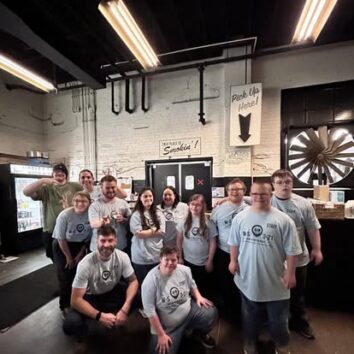
We’ve also introduced the WS321 pop-up restaurant series, where we have ten to twelve self-advocates who go to area eateries and do a shift with the staff. We promote the restaurant, and our families go to eat there, so a win/win!

We’ve had our 5k race, called the Deacon Dash, since 2017. That really started our relationship with Wake Forest University.

DAVID: Tell us a bit more about the DSA’s relationship with Wake Forest.

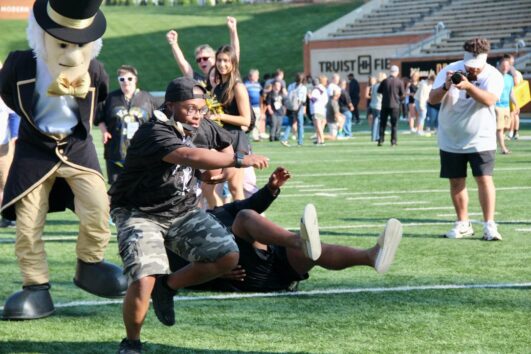
JAY: That’s been great and mutually beneficial. In addition to the Deacon Dash, we also have our Victory Day with the football team, which we began right after I started. We usually have about 50 of our members go out for a few hours in April. They get to visit the stadium locker room and put on jerseys, then run out of the field house with the football team on either side, the band playing and the cheerleaders cheering. After that, they break into smaller groups for a variety of activities with the football team. That’s been a huge hit and is definitely one of my favorite events. Their old coach retired last year, so we gave him an award at our gala. As it turns out, their new coach has a niece with Down syndrome, so I think our partnership with Wake Football will continue to grow. Our folks love it and it’s very popular with the student athletes, too. We’ve had ex-players who have gone on to the NFL who’ve worn our logo on their cleats for “My Cause My Cleats”.

We have 14 members of Wake’s Kappa Delta sorority coming tonight to participate in our Teen Time program. We gave the KD’s our “Buddies of the Year Award” last year, because they come work at all our events – they’re awesome!

DAVID: Having been an executive director, I know that male leaders of Down syndrome organizations are a rarity. Why do you think that is and what do you think other men are missing by not considering this career path?

JAY: That’s a good question and a hard one to answer. Men are definitely missing out. At one of the first Down Syndrome Affiliates in Action (DSAIA) Conferences I attended, I met Mac Macsovits, with whom I have a lot in common, so it was good getting to know him. Non-profits need to take a chance on finding men and vice versa. I was a college soccer coach for 12 years and I took a chance, and it has been a great experience. I think the more men that come into the field, the more men will consider the possibility. It did seem that there were more men at this year’s DSAIA Conference than I’ve seen before, so that’s promising. There are other jobs in the for-profit sector where you can make more money, so that probably accounts for part of it.

DAVID: But do you get hugged as much in for-profit?

JAY: No, definitely not!

DAVID: We are grateful that your group is supporting the project to update and expand the GLOBAL Adult Guidelines with a generous multi-year pledge. Why is this project, GLOBAL’s research and medical care work, and our Washington, DC advocacy important to you and the families you serve?

JAY: It has been important for us to focus on our local community, and we don’t have the resources to advocate the way GLOBAL does in Washington, or to work with research institutes the way you do. So, we think it’s important to support organizations that do have the resources and connections, because in the end your work is helping our members. We also do that in other ways. For example, instead of running summer camps, we give scholarships for kids to attend existing camps. We like the work you’re doing and think the best way to support that is to support GLOBAL.

DAVID: We really appreciate it. That’s similar to how we think about the work of other organizations, like with the effort to protect disability programs at the Department of Education. It just makes sense for us to support the work that NDSC is already doing in that area. We don’t have the ability to do everything all the time, so it’s just smart to support those who do.

JAY: We’re all part of one big family with the same overarching goal to help our families, so it makes sense.

DAVID: Is there anything else you’d like to share?

JAY: I really want to recognize our team. We have 23 great Board members and four strong staff members executing on our mission. They work hard. I’m very glad to have the staff I work with!

Representatives Robert Aderholt and Diana DeGette to Receive GLOBAL’s Highest Honor, Celebrity TV Journalists Chuck Todd & Autria Godfrey to Emcee

DENVER, CO ( April 3, 2025) – Today, the Global Down Syndrome Foundation (GLOBAL) announced Representatives Robert Aderholt (R-AL) and Diana DeGette (D-CO) will receive GLOBAL’s highest honor, the Quincy Jones Exceptional Advocacy Award, at their annual AcceptAbility Gala on Wednesday, May 21st at the Marriott Marquis Washington, DC. Each year, the awards are bestowed upon Members of Congress from both sides of the aisle who have gone above and beyond to support GLOBAL’s mission to elongate life and improve health outcomes for people with Down syndrome.

Six-time Emmy® Award-winner and NBC News’ chief political analyst Chuck Todd will co-emcee the gala. Todd was the former moderator of NBC’s flagship Sunday program Meet the Press from 2014 to 2023, and is currently the host of The Chuck ToddCast, a near-daily podcast offering in-depth interviews with political figures, experts, and thought leaders. Three-time Emmy Award-winning former WJLA ABC News anchor Autria Godfrey will co-host alongside Todd and bring her Good Morning Washington energy to the event. Multiplatinum artist and actor Phillip Phillips, soloist and member of the Maryland-based RhythmXpress dance team Robert Wallop, and GLOBAL Ambassador and actor from Baltimore Tucker Emry will headline this inspirational event. Tickets, Tables and Sponsorships are now available here.

The evening also features Congressional Hosts including Senators Cory Booker, Steve Daines, John Hickenlooper, and Jerry Moran; and Representatives Katherine Clark, Tom Cole, Rosa DeLauro, Lois Frankel, Richard Hudson, Eleanor Holmes Norton, Pete Sessions, and Pete Stauber.

In addition, each year at the gala, two students with Down syndrome are provided post-secondary GLOBAL Advancement Awards named in honor of Representatives Tom Cole (R-OK) and Rosa DeLauro (D-CT). The winners will be announced on May 21st at the AcceptAbility Gala, and it is anticipated that the representatives will present the awards at the event.

GLOBAL’s annual AcceptAbility Gala brings together policymakers from both sides of the aisle, key scientists from the National Institutes of Health (NIH), and the Down syndrome community. Each year, the gala recognizes two Members of Congress with their highest honor, the Quincy Jones Exceptional Advocacy Award. Past recipients include Representatives Tom Cole, Rosa DeLauro, Pete Sessions, Eleanor Holmes Norton, Cathy McMorris Rodgers, Katherine Clark, Pete Stauber, Lois Frankel, and Richard Hudson; and Senators John Hickenlooper, Jerry Moran, Steve Daines, and Tom Harkin.

Other notables include AcceptAbility Gala Board Co-chairs Natalie Farr Harrison, Senior Vice President of Government Relations at Avoq, and her husband, Guy Harrison, a Partner at OnMessage Inc.

The AcceptAbility Gala Board consists of business and government advocacy leaders as well as leaders in the Down syndrome community. In addition to the Harrisons, the board includes Jan Adams, Founder & CEO JMA Solutions; John Ashbrook, Founding Partner, Cavalry LLC; Amy Best Weiss, Executive VP, Global Government Affairs, American Express; Kevin Brennan, Principal, Bluebird Strategies; Emilie Eager, Director of Business Development, Julie Parker Communications; David Egan, Quincy Jones Awardee, self-advocate and author, from Vienna, VA; Felicia Emry, Esq., Life Skills Program Coordinator and Client Care Liaison, Heaven on Earth NOW; Erin Book Mullen, Principal, Williams & Jensen, PLLC; Matthew Perin, Head of Government Relations and Regulatory Affairs, Kroger; Cliff Riccio, Senior Vice President and Chief, Government Relations, NCTA; Julie Riccio, Director of Regulatory Affairs and Public Policy, PwC;  Frank Stephens, GLOBAL board member, GLOBAL Ambassador, self-advocate and actor, from Fairfax, VA; Richard Waysdorf, Legal Consultant, Global Down Syndrome Foundation; and Michelle Sie Whitten, President & CEO, Global Down Syndrome Foundation.  

The AcceptAbility Gala supports the Global Down Syndrome Foundation, funding life-changing government advocacy, research, and lifesaving medical care for children and adults with Down syndrome. Down syndrome is the most frequent chromosomal condition, affecting an estimated 400,000 Americans, but it has been one of the least-funded genetic condition by NIH.

With GLOBAL’s leadership bringing together multiple stakeholders, the NIH Down syndrome research and medical care budget has increased by $440 million over the last seven years. The AcceptAbility Gala is an opportunity to celebrate major new federal research funding increases after years of being one of the least funded genetic conditions and to educate Congress and the community about the transformative DeOndra Dixon INCLUDE Project Act that ensures funding that will elongate life and improve health outcomes for people with Down syndrome.

The AcceptAbility Gala starts at 6:00 p.m. with a reception and red carpet followed by dinner, a live auction, and performances by local dancers with Down syndrome and Multiplatinum artist and actor Phillip Phillips. Tickets start at $700 and can be purchased online at www.globaldownsyndrome.org. To cover the event or receive photos or b-roll, contact Shawn Flaherty at 703-554-3609. For more information, visit www.globaldownsyndrome.org.

###

About the Global Down Syndrome Foundation
The Global Down Syndrome Foundation (GLOBAL) is the largest non-profit in the U.S. working to save lives and dramatically improve health outcomes for people with Down syndrome. GLOBAL established the first Down syndrome research institute and supports over 400 scientists and over 2,700 patients with Down syndrome from 33 states and 10 countries. Working closely with Congress and the National Institutes of Health, GLOBAL is the lead advocacy organization in the U.S. for Down syndrome research and care. GLOBAL has a membership of over 110 Down syndrome organizations worldwide, and is part of a network of Affiliates – the Crnic Institute for Down Syndrome, the Sie Center for Down Syndrome, the University of Colorado Alzheimer’s and Cognition Center – all on the Anschutz Medical Campus, and the GLOBAL Adult Down Syndrome Clinic at Denver Health.

GLOBAL’s widely circulated medical publications include Global Medical Care Guidelines for Adults with Down Syndrome, Prenatal & Newborn Down Syndrome Information, and the award-winning magazine Down Syndrome World TM. GLOBAL also organizes the annual AcceptAbility Gala in Washington DC, and the annual Be Beautiful Be Yourself Fashion Show, the largest Down syndrome fundraiser in the world. Visit globaldownsyndrome.org and follow us on social media Facebook, X, Instagram, LinkedIn, and YouTube.

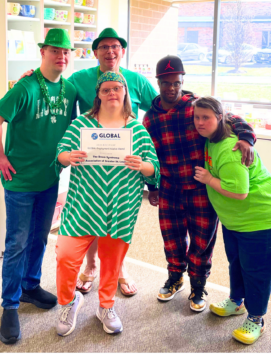
March 2025 – The Global Down Syndrome Foundation (GLOBAL) is thrilled to announce the 2025 recipients of our distinguished GLOBAL Employment Awards! GLOBAL awarded $16,000 in Employment Awards to eight outstanding Down syndrome organizations in the U.S. and internationally, funding innovative programs that provide meaningful vocational training and employment opportunities for people with Down syndrome.

At GLOBAL, we are committed to improving the lives of individuals with Down syndrome. Since 2011, GLOBAL has issued 345 awards for critical education and employment programs. To date, we have invested over $1.2 million dollars in our Down syndrome member organizations across 35 states and six countries, creating life-changing opportunities for self-advocates and the broader Down syndrome community.

The GLOBAL Employment Awards are a key benefit for GLOBAL member organizations. These awards foster collaboration and fund local programs that make a direct and positive impact by creating or expanding meaningful employment for self-advocates.

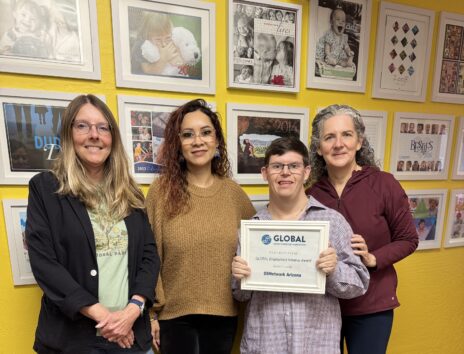
Members of the DSNetwork Arizona team

This year’s GLOBAL Employment Awards will underwrite eight dynamic programs across Arizona, Colorado, Kentucky, Missouri, Nebraska, Virginia, Wisconsin, and Uganda. These programs will impact over 5,000 people and will offer everything from job coaching and skills training to paid ambassador roles and expanded hours for self-advocate employees.

“DSNetwork’s Programs Assistant role provides meaningful employment for Brendan, a self-advocate with Down syndrome,” says Jennifer O’Connell, Executive Director of DSNetwork Arizona. “With this funding, we can foster independence and confidence and also promote social inclusion by highlighting the capabilities of individuals with Down syndrome in the workplace. We are incredibly grateful for GLOBAL’s support!”

GLOBAL is honored to partner with these incredible organizations in their commitment to creating inclusive employment opportunities. Please join us in congratulating our newest 2025 GLOBAL Employment Award Recipients listed below and celebrating the amazing work they are doing!

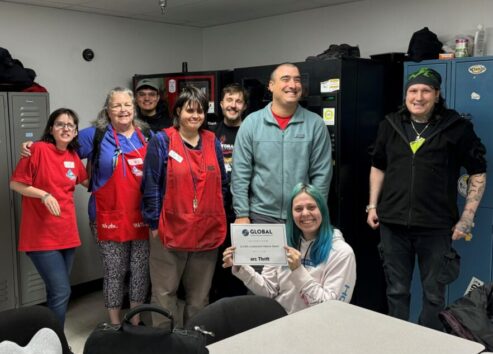
Arc Thrift, Lakewood, CO: Working for a Purpose will provide additional hours for existing employees with Down syndrome and support the hiring of new employees, expanding the organization’s inclusive workforce.

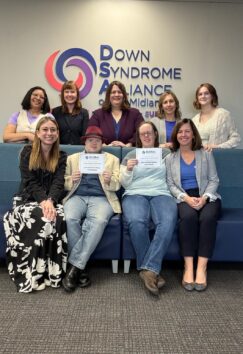
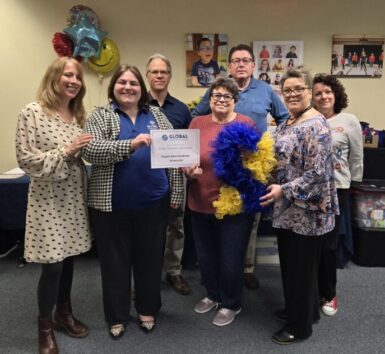
Down Syndrome Alliance of the Midlands, Omaha, NE: Funding for Self-Advocate Office Assistants & Program Assistant will allow one of their two office assistants to expand her hours. She will create educational presentations for students in the education and medical fields and engage in public speaking to raise awareness.

The Down Syndrome Association of Greater St. Louis, Brentwood, MO: Ready 2 Work Peer Mentorship supports the hiring of 1-3 peer mentors with Down syndrome to assist with their Ready 2 Work activities, expanding opportunities for peer-to-peer support, and job readiness.

Down Syndrome Association of Wisconsin, Wauwatosa, WI: Funding for Self-Advocate Office Assistant will increase the hours of a self-advocate office assistant and her job coach from 10 hours per week to 12 hours per week, supporting skill-building and professional development.

Down Syndrome Foundation Uganda Ltd., Kampala, Uganda: Arts and Crafts Skills Training will provide training in arts and crafts for self-advocates, empowering them to create and sell their work, building confidence, independence, and entrepreneurial skills.

DSNetwork Arizona, Tempe, AZ: Funding for Self-Advocate Employment will support the continued employment of a Programs Assistant with Down syndrome, focusing on developing professional skills, community engagement, communication, and teamwork.

Down Syndrome of Southern Kentucky, Bowling Green, KY, Scoops of Joy will hire a job coach to work with their self-advocate employees, allowing their mobile ice cream truck program to accept more bookings and expand operations beyond the availability constraints of current staff.

Virginia Down Syndrome Association, Richmond, VA: Self-Advocate Training and Ambassador Program employs self-advocates to represent the organization at community events while building self-determination and advocacy skills.

To learn more about the GLOBAL membership awards, visit https://www.globaldownsyndrome.org/global-awards/

To learn more about individual and organization GLOBAL memberships, visit https://www.globaldownsyndrome.org/global-membership/

To learn more about Global Down Syndrome Foundation, visit www.globaldownsyndrome.org  


About Global Down Syndrome Foundation

The Global Down Syndrome Foundation (GLOBAL) is the largest non-profit in the U.S. working to save lives and dramatically improve health outcomes for people with Down syndrome. GLOBAL has donated more than $32 million to establish the first Down syndrome research institute supporting over 400 scientists and over 2,500 patients with Down syndrome from 33 states and 10 countries. Working closely with Congress and the National Institutes of Health, GLOBAL is the lead advocacy organization in the U.S. for Down syndrome research and care. GLOBAL has a membership of over 100 Down syndrome organizations worldwide, and is part of a network of Affiliates – the Crnic Institute for Down Syndrome, the Sie Center for Down Syndrome, and the University of Colorado Alzheimer’s and Cognition Center – all on the Anschutz Medical Campus.

GLOBAL’s widely circulated medical publications include Global Medical Care Guidelines for Adults with Down Syndrome, Prenatal & Newborn Down Syndrome Information, and the award-winning magazine Down Syndrome World  ™. GLOBAL also organizes the Be Beautiful Be Yourself Fashion Show, the largest Down syndrome fundraiser in the world. Visit globaldownsyndrome.org and follow us on Facebook, X and Instagram.


GLOBAL’s WDSD Campaign Aims to Raise $25,000 for Life-Saving & Transformative Research & Medical Care

DONATE between now and MARCH 31st to help us reach our goal!

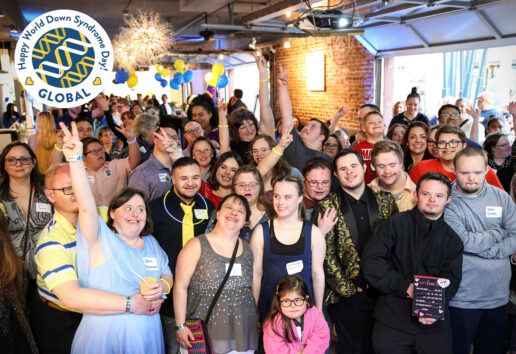
DENVER, SYDNEY, KAMPALA, NYC, GENOVA, March 20, 2025 – Today, the Global Down Syndrome Foundation (GLOBAL) announced their World Down Syndrome Day celebrations in Denver, New York City, Australia, Uganda, and Italy. The foundation, which provides evidence-based, free medical care guidelines for children and adults with Down syndrome, aims to raise $25,000 for their World Down Syndrome Campaign. One hundred percent of the proceeds go to life-saving and transformative research and medical care for patients with Down syndrome from 33 states and 10 countries.

As World Down Syndrome Day approaches on March 21st (signifying that people with Down syndrome have 3 copies of chromosome 21), GLOBAL is gearing up for several celebrations and impactful initiatives around the world:

Denver, USA – World Down Syndrome Day EPIC Dance Party

  • Over 200 people and local celebrities have already signed up for GLOBAL’s Friday, March 21st event at the fabulous Cherry Creek Shopping Center with additional sponsorships from Kona Grill, Developmental Pathways, and Ricki & Dave Rest; Register and donate today HERE
  • Thanks to GLOBAL’s amazing friends at Kroenke Sports Charities who are lighting up Ball Arena blue & yellow in the morning

Sydney, Australia – Down Syndrome Symposium Australia

  • Featuring GLOBAL/Crnic Institute Director Dr. Joaquín Espinosa and GLOBAL Adult Guideline Author Dr. Dennis McGuire
  • Supported by GLOBAL, Down Syndrome Institute, Siblings Australia, The Hon. Dr. Mike Freelander MP and more
  • Saturday March 22nd – Sunday March 23rd at Wesley Conference Centre, 220 Pitt Street, Syndey CBP 10:00 AM – 5:00 PM – FREE & Open to the Public!

New York City, USA – United Nations Conference

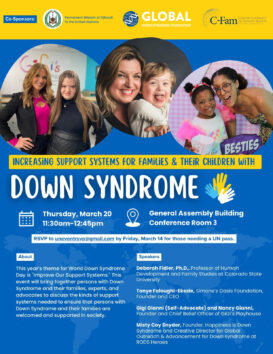
  • Featuring GLOBAL/Crnic Institute Researcher Deborah Fidler, PhD, Professor of Human Development and Family Studies at Colorado State University; Other speakers include Tonye Faloughi-Ekezie, GiGi Gianni and Nancy Gianni, Misty Coy Snyder
  • Thursday, March 20th 11:30 – 12:45 PM, General Assembly Building Conference Room 3 – FREE & Open to the Public

Australia Symposium graphic       

Genoa, Italy – “No Decision Without US” CoorDown Video

  • Featuring GLOBAL International Spokesperson Caterina Scorsone & talented Self-Advocates
  • GLOBAL is proud to support this important video created by CoorDown in Italy

Denver, USA –Important World Down Syndrome Day Video from GLOBAL

  • Featuring Self-Advocates from Around the World

Kampala, Uganda – World Down Syndrome Day Awareness Events

  • Featuring an Awareness March in the city, an exhibit for people with DS to share their skills (dance, pottery, baking, arts), and a Resource fair to support families
  • GLOBAL and the Global Livingston Institute are working with local Down syndrome and intellectual disability NGOs to organize these fun and inspiring events


“We are so honored to be a part of World Down Syndrome Day initiatives in Denver, NYC, Australia, Italy, and Uganda this year,” says GLOBAL President & CEO Michelle Sie Whitten. “We are now actively working in 10 countries translating and distributing our Prenatal & Newborn Pamphlet, GLOBAL Adult Guideline, and other important resources at no cost to hundreds of thousands of people with Down syndrome and their families. We could not do this without our wonderful in-country collaborators, the leaders on our GLOBAL Membership Advisory Board, and our affiliates, families and champions. Everyone at GLOBAL works so hard, and  it is lovely to have a day where everyone can just celebrate our progress and the awesome people with Down syndrome we serve!”

World Down Syndrome Day falls on March 21st or “3-21” signifying the fact that people with Down syndrome are born with 3 (three) copies of chromosome 21 instead of 2 (two). World Down Syndrome Day was promulgated by the United Nations in 2012 and is celebrated in 190 countries. 

To learn more about the Global Down Syndrome Foundation and World Down Syndrome Day, visit www.globaldownsyndrome.org/world-down-syndrome-day-month.

###

About the Global Down Syndrome Foundation
The Global Down Syndrome Foundation (GLOBAL) is the largest non-profit in the U.S. working to save lives and dramatically improve health outcomes for people with Down syndrome. GLOBAL established the first Down syndrome research institute and supports over 400 scientists and over 2,700 patients with Down syndrome from 33 states and 10 countries. Working closely with Congress and the National Institutes of Health, GLOBAL is the lead advocacy organization in the U.S. for Down syndrome research and care. GLOBAL has a membership of over 110 Down syndrome organizations worldwide, and is part of a network of Affiliates – the Crnic Institute for Down Syndrome, the Sie Center for Down Syndrome, the University of Colorado Alzheimer’s and Cognition Center – all on the Anschutz Medical Campus, and the GLOBAL Adult Down Syndrome Clinic at Denver Health.

GLOBAL’s widely circulated medical publications include Global Medical Care Guidelines for Adults with Down Syndrome, Prenatal & Newborn Down Syndrome Information, and the award-winning magazine Down Syndrome World TM. GLOBAL also organizes the annual AcceptAbility Gala in Washington DC, and the annual Be Beautiful Be Yourself Fashion Show, the largest Down syndrome fundraiser in the world.

Visit globaldownsyndrome.org and follow us on social media (Facebook & Twitter: @GDSFoundation, Instagram: @globaldownsyndrome, YouTube: @GlobaldownsyndromeOrg, LinkedIn: @global-down-syndrome-foundation). 


Down Syndrome Alabama, established in 1987, is the leading champion in its state for individuals with Down syndrome. Recent initiatives include their CHAMPS program, providing social and education opportunities to post-secondary students,  their EDGE UP learning program for schoolchildren, and their HEADS UP program, which teaches meaningful advocacy to elementary students.

GLOBAL Vice President – Strategic Alliances, David Tolleson, met with Melissa “Missy” Haughery, M.S., Executive Director of Down Syndrome Alabama, to learn more about the organization, its recent initiatives, and more.
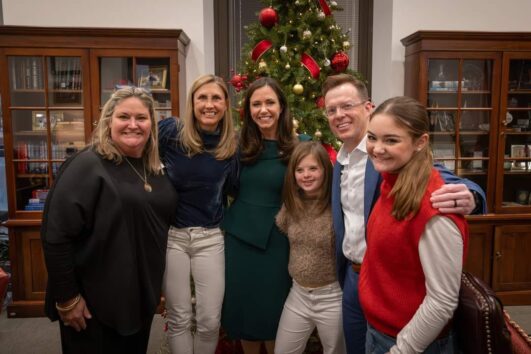
DAVID: Tell us a bit about yourself and how you got involved with Down Syndrome Alabama?

MISSY: I am an educator. I was a 12th grade English teacher for 26 years. My goal was to become a middle school assistant principal. However, when I became pregnant with twins – one of whom has Down syndrome – and I realized that I would have 3 children under the age of 3, I realized that I may have to push my professional goals back a bit. As time went on, I realized that being at basketball games until 8 pm probably wasn’t the wisest choice for my family, so as I neared the 25-year mark, I decided it was time to come out of the classroom. I loved teaching, but it was time for a change. The DSA Executive Director job came open and my husband encouraged me to apply. I didn’t want to, because I thought it should be someone outside of the Down syndrome community, because I thought it might be hard for folks to distinguish between my professional life and my personal life as a mom. In late summer of 2022, I submitted my resume, and I started in March of 2023. My master’s degree is in educational leadership, so instead of leading a school, I’m leading an organization that educates people.

DAVID: Tell us a bit more about Down Syndrome Alabama.

MISSY: Down Syndrome Alabama has been around since the late 70’s/early 80’s when it was formed as a parent advocacy group. Parents felt like if they came together, they’d have a stronger voice. They incorporated under the name PADS – Parent Advocacy for Down Syndrome. It was a parent-run, mom-and-pop organization that grew very organically, but very quickly. In 2012, they changed the name to Down Syndrome Alabama, and it became a shift from mom-and-pop to a more professionally run and led organization. As was the case with many organizations, 2020 led to quite a bit of change with a new Executive Director who implemented a lot of policies and procedures to continue the growth and expansion into some satellites and that’s where we are today.
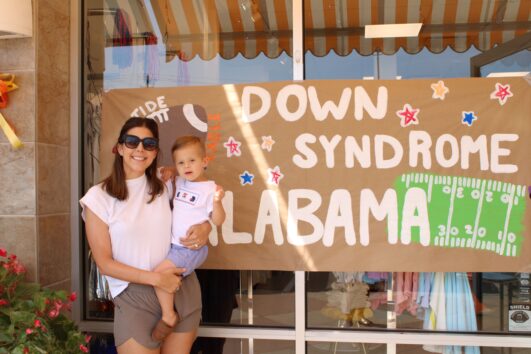
 

DAVID: Last year, Down Syndrome Alabama received DSAIA’s “Affiliate of the Year” Award. Tell us a bit about that recognition and what it means to you.

MISSY: That recognition was amazing, and we weren’t expecting it at all, especially since I’d only be in the role for a year. One of the main things we talked about was a program that we’d introduced where we partnered with an artist named Carolyn Lewis. She created a piece of art named an empowerment bird. It came about because we have our new parent bag with things for the baby, but I thought we needed something for the parent that says, “Hey, you’ve got this. It may be tough, and it may not be the road you planned, but you’ve got this.” We were able to create smaller replicas for our parents. When I met with the artist, the piece became more special, because she was inspired to become an artist by a boy she used to babysit who had Down syndrome. We had the boy, who is now an adult, at the unveiling. It was a surprise for him and his family, as the artist explained how he inspired her work.

We have our new parent outreach and our CHAMPS program, which provides post-secondary adults with social and educational opportunities 1 to 2 times per month. For example, we have a self-defense class taught by the Hoover, AL, Police Department, because what could be more empowering than to feel safe and confident? As we are growing in society and things like Ubers are going to be used more frequently by people with Down syndrome, what are those safety measures they need to be aware of in those situations?

We also have a program that is funded through a GLOBAL Education Award, which is our LACE UP program. It is a “Couch to 5k” running program for adults. We’re hoping to expand that to younger kids and caregivers, because having everyone in the family involved is important for long-term adoption of an exercise program by self-advocates. We want to get them off the couch and moving however they can, whether that’s walking or running. We’re proud to have Daniel Chaplin, a self-advocate who has run half-marathons in all 50 states, as a part of our group. Not everyone is as athletic as Daniel, but if we can get everyone a little closer to his level – even if they’re not running marathons – wouldn’t that be great?

We also have an educational program to help schoolchildren with Down syndrome meet the criteria they’ll need to participate in a post-secondary program like Auburn’s Eagles Program, ClemsonLIFE, or the Access Program at Mississippi State. Additionally, we have our HEADS UP program, where we go into elementary classrooms or to Cub Scout or Girl Scout groups to teach younger generations about how to be an advocate. HEADS UP actually stands for “Helping Everyone Advocate for Down Syndrome”. We teach them at a level appropriate for their age, because everyone can advocate, and then leave them with a book for their classroom and a certificate and a bow for their door.
My personal philosophy for our organization is “see us, know us, love us,” because I feel the more we are seen in society, the more people will get to know us, and then they’ll come to love us. I try very hard to make sure that when we have programs or activities, we do them in public places.

DAVID: In addition to your many great programs, you also have a very unique fundraiser!

MISSY: Yes! We partner with Clyde May Whiskey for a bourbon and spirit tasting event. Clyde was a bootlegger who went to prison for making and selling alcohol illegally, but he also had a daughter with Down syndrome, and he raised her in his home with his other children at a time when society believed it best to do otherwise. So to the Down syndrome community, Clyde May was a trailblazer. Clyde’s grandson comes to the event, tells stories of the label and of his grandfather’s love for his daughter, Debbie. This year, we elevated the event to include a guest bartender, Wilson Taylor, a young man who has Down syndrome, because bartending is empowering! The story gets even better because the CEO of the Clyde May brand also has a daughter with Down syndrome. Pretty cool.

DAVID: Cool, indeed. As is the fact that you have a new Down syndrome clinic forming in Birmingham! How is Down Syndrome Alabama supporting that effort?

MISSY: The plan is for it to be a lifespan program but they’ve started with pediatrics earlier this year and already have patients scheduled through June, which shows the level of need. Patients can see a pediatrician, audiologist, psychologist, and speech therapist, as well as a social worker who can help advocate for appropriate supports in the school setting. They’re working on getting an OT, cardiologist, and endocrinologist. The clinic is through the University of Alabama – Birmingham (UAB). My hope is that from here, UAB will jump on board with Down syndrome research. We support their work, and they will be giving out our new parent bags, which is great, because the parents might not know to call us. The clinic will also be offering a family summer camp weekend that we’ll play a role in. It will be a great opportunity for families to connect with one another – it’s huge to meet others who are in your shoes. As a parent, I’ve always thought it’s important for my children without Down syndrome to meet other siblings, because when I’m long gone, they’ll need a support system.
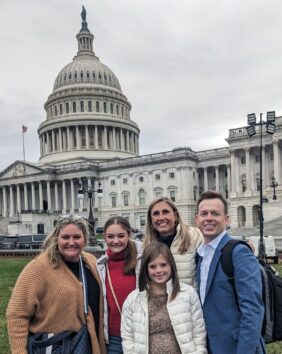
DAVID: Tell us about your experience with GLOBAL’s DeOndra Dixon fly-in.

MISSY: It was an experience that was educational and one that I never thought I would do. When we arrived Tuesday and met with the GLOBAL staff, it was empowering and taught me so much about what to do and the purpose of our visit, that it gave me the confidence that I needed the next day to go meet with our Senators. The Davis family went with us and Grace, who has Down syndrome, is a recent graduate from the Auburn Eagles program. I asked Grace and her family to come, because of her connection to Auburn, where Senator Tommy Tuberville used to be head football coach. Coincidentally, Grace’s mom grew up dancing with our other senator, Katie Britt, which was a great connection. They also felt so empowered after our meetings with the senators.
GLOBAL’s Congressional briefing was amazing – standing room only! I was sitting next to a staff member from Minnesota who said, “I heard Jamie Foxx would be here talking about Down syndrome and what could be better than Jamie Foxx and Down syndrome?!” Then, as we were leaving, we saw JD Vance and I thought, “Oh my gosh, he’s the Vice President-elect!” Grace did an amazing job making the Auburn connection with Senator Tuberville and then spoke eloquently to Senator Britt about herself and her accomplishments, but also spoke about her fears, some of which are medical issues. After Grace finished speaking, Senator Britt looked at her and said, “Grace, I would be honored to co-sponsor this bill for you.” We were so excited! I felt like we flew up to DC, did our job, and it was amazing! It was very validating knowing that we had worked hard and done something right. And, of course, what could be more fun than ending the night with Jamie Foxx singing “Push it” by Salt n Pepa, while everyone was dancing? It was one of those out of body experiences! Nothing I could’ve ever imagined doing!

DAVID: We are grateful that Down Syndrome Alabama is supporting the project to update and expand the GLOBAL Adult Guidelines with a generous multi-year pledge. Why is this project, GLOBAL’s research and medical care work, and our Washington, DC advocacy important to you and the families you serve?

MISSY: One of the biggest calls I get is from people who say, “I need to find a doctor who will see my adult with Down syndrome.” I think that if we’re not able to educate every physician on Down syndrome, we need to at least be able to educate the families to say to their physicians, “here are the Guidelines and I need you to do what’s on the checklist.” To me, that’s just the easier route to ensure better healthcare for people with Down syndrome. Down syndrome is delightful, but it’s the medical issues that can be the hard part. You can’t control health in the same way you can control educational access, for example. The 21st chromosome contains many mysteries. I believe GLOBAL’s work will unlock these mysteries not only for people with Down syndrome, but for all of us.

DAVID: Is there anything else you’d like to share?

MISSY: I feel like we as a community are being seen more and progress is being made, but so much more needs to happen. I’m so proud to be a part of this and I hope that in a few decades, some of the things we celebrate will not need to be celebrated because they’ll be the norm. It’ll be the norm that you have an adult with Down syndrome working for UPS and not a celebration because he’s the only one.

DAVID: Thank you, Missy!

MISSY: Thank you to everyone at GLOBAL! You’re amazing people doing the work you’re doing.